Showing posts with label Humanities. Show all posts

Monday, 22 July 2013

Graduates Enjoy Their Day In The Sun

Words & Videos By Neil Harrison

Photographs By Jason Cooke & Bethan Grant


Manchester's latest graduates celebrated in the sunshine - following their end of year ceremony at a packed Bridgewater Hall.

In spite of the heat, humanities students from Manchester Metropolitan University wore caps and gowns to receive their accolades in front of proud family and friends, before heading back to MMU's Business School for a well-deserved champagne reception and prize-giving ceremony.

Video: James Draper, of MMU's English Department, congratulates recent Humanities graduates and explains the importance of the work done by the faculty.


Dr. Aidan Arrowsmith, also of the university's English department, addressed the successful graduates in attendance directly, adding,

“I wanted to say how hugely impressed myself and my colleagues are with how hard you have all worked to get to where you are today. Some of you have put in super-human efforts, it's really quite inspiring for us.”

The day also saw veteran journalist and T.V. Presenter, Dame Joan Bakewell, return to her home town to receive an honorary Doctorate of Letters from MMU. She said,

“I have great memories of catching the bus into Manchester form Stockport to visit the Central Library or the Free Trade Hall. To see, today, one of the great cities of 19th Century Europe flourishing once again is wonderful.”

Video: Photographs from MMU's Humanities Class of 2013 Graduation


For more information visit mmu.ac.uk

Neil Harrison is studying Social History at Manchester Metropolitan University. He is an aspiring journalist and a terrible guitar player. Read his blog LooseRiver and follow him on Twitter @LooseRiver

Thursday, 30 May 2013

Improving the Student Experience


The Humanities, Languages and Social Science Learning & Teaching event, 23rd April 2013, MMU
Late in the Spring term, the Faculty of HLSS enjoyed a day sharing areas of positive learning and teaching practice from across the Faculty. Colleagues from all Departments provided a fascinating showcase of their learning and teaching innovations, giving colleagues an opportunity to reflect on the ways in which the Faculty can continue to improve the student experience.

The showcase was opened by Dr Jess Edwards (Associate Dean, Student Experience) and Dr Annabel Kiernan (Faculty Learning and Teaching Fellow). In his opening remarks, Dr Edwards highlighted that the Faculty had been shortlisted in both the overall Teacher of the Year (Debora Green) and overall Department of the year (won by History, Politics & Philosophy) categories in the 2013 MMUnion teaching awards, setting the tone for celebrating the thoughtful work of colleagues across all of our programmes.
The showcase event comprised three themes: e-learning, internationalisation and employability and a presentation on Research Methods by Dr Julie Scott-Jones & Dr John Goldring, Sociology 'TCP:  Soothing away the barriers to student learning of quantitative methods'. Colleagues presented snapshots of their practice within each theme, leaving time for questions and broad discussion reflecting on what works well, identifying challenges and identifying ways to further develop good practice.

Theme 1: E-Learning
The Faculty continues to add to the diversity of learning and teaching delivery through innovating in e-learning; from developing online courses to enabling different learning styles through technology-enhanced provision.
In this session, presentations were given on 'Using Social Media to Extend and Enhance Teaching' (Dr John Scanlan, Sociology) The Virtual Writing School: MMU’s International Online MA in Creative Writing (Dr James Draper, English) and 'Podcasting Lectures: The Lessons of History’ (Dr Gervaise Phillips, History)
Theme 2: Employability and Curriculum Enrichment
Graduate employability is a priority for our students and as a Faculty we encourage students to take advantage of the employability and curriculum enrichment activities on offer. These range from placement working to volunteering roles and improving professional skills.
Presentations were given on ‘English in Practice: Learning from our mistakes’ (Dr Lucy Burke, English), ‘Politics and the workplace’ (Dr Janet Mather, Politics) and ‘Developing Employability Skills by using Structured Ethical Reflection’ (Roz Fox, Public Services)
Theme 3: Internationalisation
This session provided a showcase of some of the international collaborations we have in the Faculty at both undergraduate and postgraduate level. The Faculty continues to internationalise the learning experience through opportunities for study abroad, collaborative curricula and international research projects.
Presentations were given on Transatlantic Public Administration and Policy (Mr Frank Carr, Public Services), ‘It’s not what you say, it’s the way that you say it’ (Jon Wright, Languages& Info Comms) ‘MA European Urban Cultures - the challenges and benefits of teaching collaboratively with other European universities' (Dr Katie Milestone & Dr Robert Grimm, Sociology), and ‘Making the obvious strange: teaching philosophy’ (Professor Joanna Hodge & Dr Anna Bergqvist, Philosophy)
‘Talking Tables’

As part of the showcase event colleagues were given the opportunity to follow-up on the themes of the day and to explore ways of further enhancing the learning and teaching practice in all programmes in the Faculty. Discussion forums were facilitated on the day by a series of ‘talking tables’ on:
·         The student journey (facilitated by Steph Taylor and Sam Connolly)
·         Feedback & Assessment (facilitated by Aiden Arrowsmith)
·         Retention (facilitated by Paula Ierston)
·         International Collaboration in teaching & Learning (facilitated by Stephanie Aldred)
·         Employability & Curriculum Enrichment (facilitated by Lucy Burke)
·         Digital, Online & Social Media (facilitated by Richard Eskins)
·         Inclusivity (facilitated by Jess Edwards
The event was a great showcase of the ways in which colleagues reflect on their practice and innovate their learning and teaching to constantly improve the student experience.
Over 100 colleagues participated in the events across the day and, as a Faculty-wide event, it also offered a good opportunity to welcome new colleagues and to identify areas for more cross-Departmental collaborative working.

The Faculty will host further learning and teaching events, in both the Autumn and Spring terms – everyone welcome!


Friday, 3 May 2013

A Celebration for Collaborations


Esmail Patel collaborates with Manchester Metropolitan University and The University of Manchester to aid D/deaf Learners with University Choices, Wednesday, 24th April, Geoffrey Manton Building, MMU

Words by Siobhán O'Toole


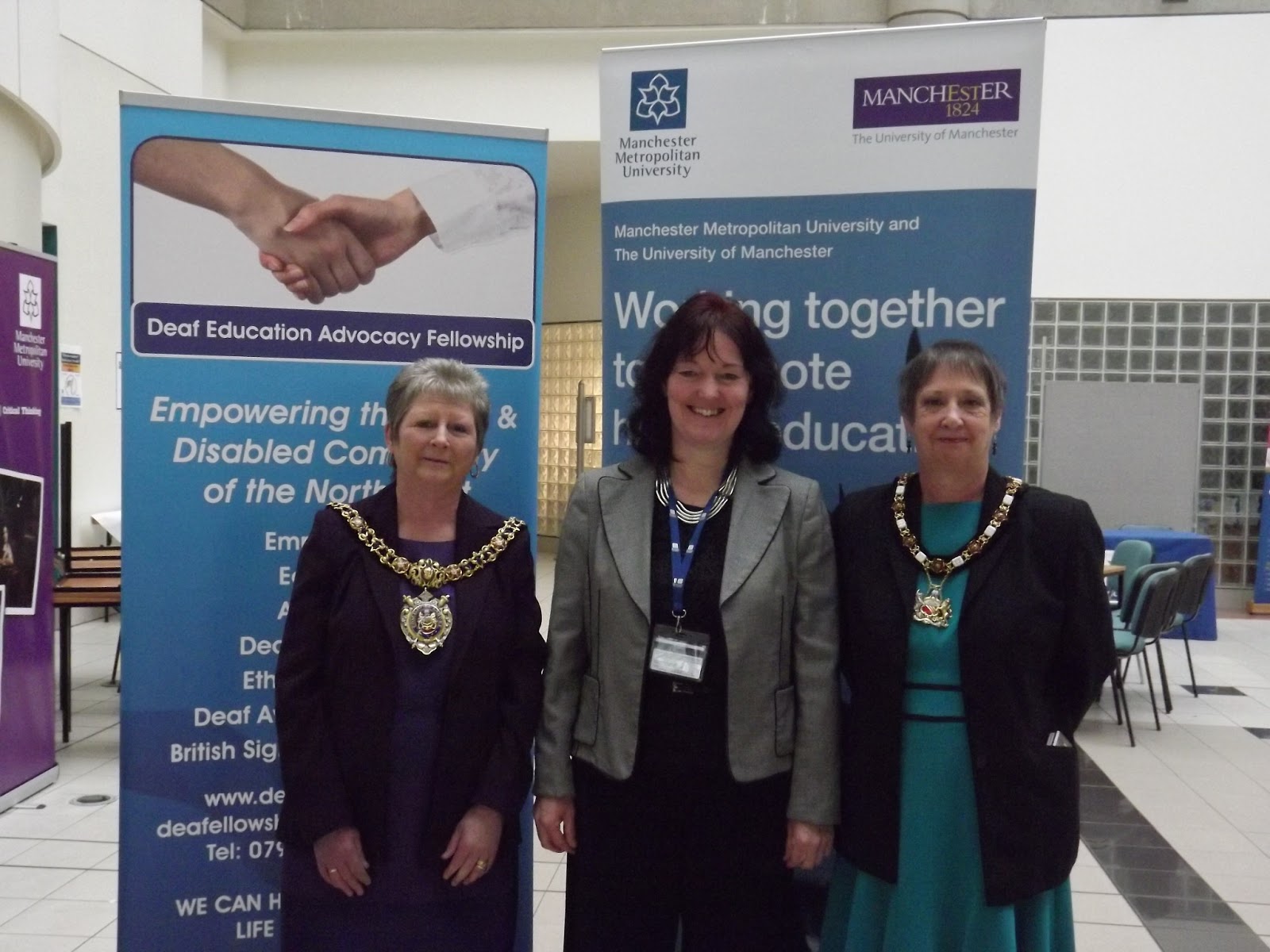
Esmail Patel, Director/CEO of DEAF (Deaf Education Advocacy Fellowship), joined forces this week with Manchester’s top universities to provide a day in which D/deaf learners could acquire information needed regarding their prospective university experiences, with support from Manchester’s Lord Mayor and Lady Mayoress.

Manchester Metropolitan University (MMU), The University of Manchester (UoM) and DEAF, came together to inspire and encourage D/deaf learners of the North West, and instil in them the belief that they can attend and enjoy university just as hearing people do. During the event, Hassan Naseer, a student at UoM, speaking on behalf of the deaf university experience, said, “we are exactly the same as hearing people, and have the same rights.” With that, he summarised the main ideology of the event: D/deaf learners are able to, and should, take as much from life as any other hearing person would.

Following registration in the Geoffrey Manton atrium, and the set-up of equipment (such as screens to show typed speech in order to ensure understanding), participants filled Lecture Theatre 6, eagerly anticipating the commencement of the event. UoM’s Laura Cragg enthusiastically introduced the day’s activities, while Dr. Sharon Handley, Dean of the Faculty of Humanities at MMU, conveyed her enthusiasm by thanking everyone for attending with hopes that the event would stimulate and inspire all attendees.

It was then Lord Mayor, Councillor Elaine Boyes’s turn to speak, whose presence alone, along with Lord Mayoress, Linda Geoghegan, was inspiration enough. Her speech incorporated the story of Dame Kathleen Mary Ollerenshaw, a British mathematician and politician who was Lord Mayor of Manchester from 1975 to 1976 and an advisor on educational matters to Margaret Thatcher's government in the 1980s. Ollerenshaw became almost completely deaf at the age of eight, and reached the wonderful age of one hundred last year.


From right to left: Lord Mayor, Councillor Elaine Boyes,
Dr. Sharon Handley and 
Lord Mayoress, Linda Geoghegan
Following her impairment, Ollerenshaw quickly learned to lip-read, as well as a multitude of other skills, including sports; representing England in the women’s ice-hockey team. At 19, Somerville College, Oxford, invited Ollerenshaw to an interview, and due to her advancement in lip-reading, no one at the university knew of her profound deafness until she had started the course. She left Somerville College with a first class degree.

The Lord Mayor utilised the life of Dame Ollerenshaw extremely effectively. Through details of her devotion to education and music, the whole room was affected, moving and inspiring D/deaf and hearing people alike, a unity felt throughout the entire day.

Before presentations on Student Finance and how to budget throughout university, Esmail thanked all involved in the organisation and support of this event, whilst also introducing his community-interest company, DEAF, and its aims:

“We were set up with one aim in mind, to empower and encourage confidence within the D/deaf community, encouraging D/deaf people to achieve their goals. We work primarily with deaf people, but also within the hearing community too, to campaign and spread awareness of the possibilities for all people within higher education.”

An important point of attention for Esmail was the diversity of the DEAF group today, commenting that, ‘it doesn’t matter whether you’re culturally or linguistically deaf or oral; we want this group to be all inclusive’, whilst also conveying the significance of being independent and how higher education facilitates this. I was extremely pleased when Esmail invited me to interview him in the near future. I look forward to hearing more about his story and primary role in creating and running the community-focused organisation.


After being educated on the difficult but worthwhile process of funding via Student Finance England, ambassadors from both universities directed tours of the two campuses. The ambassadors highlighted the most interesting and impressive buildings, such as MMU’s New Business School—a £75 million building which is one of the finest and most environmentally sustainable academic buildings in the UK—and UoM’s library, the largest non-legal deposit library in the UK and the third-largest academic library, after those of Oxford and Cambridge.

Next, guest speakers, Hassan Naseer and Farkandah Khan, introduced as D/deaf role models, tried to encourage participants not to be afraid, and fully take part in university life.  Nasser, a current student of UoM, said that, “despite the problems that first year will present, such as new and frightening environments and people, it will get easier, and you will enjoy your experience.” Naseer, who is the first D/deaf student to study Electrical Engineering at UoM, also wanted to emphasise the level of support in place at universities, so that D/deaf people can learn and enjoy university like everyone else, and develop as independents. 

Farkandah, a deaf, oral learner—and graduate from MMU—told her story of hard work, persistence, multiple jobs and time at MMU. Through ‘strong self-belief, commitment, determination and passion’, Farkandah achieved her first-class degree in travel and attained the accolade of Student of the Year. She later revealed her passion for helping the disabled in Manchester by improving their day-to-day experiences. Farkandah also shared her hopes of setting up a business that focuses on the disabled; organising events and partnerships to benefit the lives of those often ignored and forgotten in society.

Another inspirational D/deaf role model, whose work has significantly improved the lives of many, is Mahmudur Rahman. Despite many financial trials and tribulations over the past ten years, Rahman managed to set-up the Rochdale Rhinos Deaf Football Club and secured sponsorship from Esmail, through DEAF. Mahmudur, who left his boarding school for the deaf at 16, found it difficult to become involved in mainstream activities as, ‘society wasn’t as accepting of D/deaf people in those days’. He quickly became involved in D/deaf football, and despite many thinking that ‘deaf people couldn’t do this’, they played against mainstream teams and beat them over and over again. He said it was ‘a wonderful feeling to prove that we had talent, even playing against hearing people.’


Mahmudur proudly detailed the history of the team, and their initial local success against hearing police teams. They represented the only D/deaf team in the league and they still continue to defeat all other teams. They had local recognition, and a progressive sense of pride in both themselves and their achievements. Unfortunately, the team did not have sufficient funding to support the success of the team, and so, after years of struggle, Mahmudur eventually approached Esmail, who was happy to accept Mahmudur’s proposals and support the ‘Deaf Rhinos’ through the sponsorship of DEAF.

It was clear to see Mahmudur’s honour and pride in his team, especially after introducing his goalkeeper, Adhil Dad, ‘the star of the team; a great player’. Adhil said that being a part of the team is ‘fantastic, [and that] being a part of something that has endeavoured so hard to progress is just incredible. I’m so proud. The sky’s the limit for the team, and who knows where we will progress from here’. Their first game with the new sponsorship, and subsequent new kits, will be on 12thMay against last year’s champions, and after fervent requests that I attend, I very much look forward to cheering them on.

The day’s event was extremely successful. It proved to be significantly beneficial to both the hearing and D/deaf participants, who learned not only about the logistics of their prospective university experiences, but also that ‘deaf people can achieve, and should not be held back, ever’. Mahmudur represented this belief by saying:

“Race doesn’t matter, religion doesn’t matter, culture doesn’t matter, regardless of who you are, you have skills and interests, and so can take from life just as much as anyone else’.

The collaboration between MMU, UoM and Esmail Patel and DEAF was clearly a success, evident in the participants’ positive acceptance of ideas regarding the potential of D/deaf individuals, the multitude of opportunities open to them, and the event’s encouragement of participants to refuse and banish perceptions of inferiority. 

Siobhan studies English Literature at Manchester Metropolitan and is an inspiring writer, hopeless optimist and romantic, and a complete technophobe. Follow Siobhan on Twitter @smo_07

Tuesday, 23 April 2013

Celebrate The Need of Humanities In The 21st Century

Do Humanities Matter in the 21st Century? Neil Harrison, Richard Reed, and Sascha Wilts all agree with a resounding and resonating… YES! 

Words by Siobhán O'Toole

Left to right: Richard Reed, Neil Harrison & Sascha Wilts
Today’s award ceremony celebrated three deserving winners who all entered wonderfully diverse pieces in reaction to the above question earlier in the year. 

The competition, launched by MMU’s Humanities Faculty, asked students from all subject areas to enter either an essay of 1000 words, or a three-minute video, which responded to the question: ‘Do Humanities Matter in the 21st century?’ The competition brief encouraged entrants to consider Humanities in regards to new media, new messages, new meanings, values and attitudes, culture, and the rising significance of the digital age. 

Dr. Jess Edwards, Head of the English Department, kindly began proceedings by introducing the significance of such a question, and reminding us that the asking of it today is not a new thought, but one that has occurred innumerable times before, notably so in dark periods of austerity. Such periods encourage societies to defend the study of Mathematics, Sciences, and subjects with clear economic benefits, but question the study of subjects such as Philosophy, Politics, History, English, Sociology, and so on. These are seen as subjects with indistinct economic benefits, despite their immeasurable influence regarding our development and improvement as people and communities. 

To convey this, Jess discussed the role of Patricia Waugh (literary critic and professor of English Literature at Durham University), and her thoughts on this significant question—one notable opinion being that such enquiries regarding the value of Humanities, in no way affect the creative output of a society. On the contrary, Waugh said that it is in times of deep austerity that the greatest works arise. 

Jess supported such views by sharing that, despite national decreases in applications to study Humanities subjects, this is not the case at MMU, which remains resilient and receives encouraging numbers of applications every year. Before introducing the three winners, and presenting them with their prizes, Jess conveyed his pride in his position as Head of the English Department, and ‘defending the role of Humanities every day’. He noted that the work entered by the three winners was, ‘marvellous, passionate, articulate and persuasive’, whilst also presenting a summary of the judges’ views on the entries as, ‘very different in style, approach and message. However, all entries were equally as convincing and stimulating as the next.’ 

It was then time for the presentation of prizes, something highly anticipated by all three winners, due to the fabulous nature of each award. Firstly, Jess presented Sascha Wilts, a German Erasmus student of English, with third prize of a £25 Amazon voucher for his essay: ‘Do Humanities matter in the 21st Century? – A Plea for Humanities’. Secondly, Jess awarded Richard Reed, a combined honours student of International Politics and Marketing, with second prize of a £100 Amazon voucher for his film, entitled with the competition question. Lastly, Neil Harrison, student of History and fellow Student Press Officer, was presented with first prize; a brand spanking new iPad, for his essay: ‘Responding To Threats: ‘Do Humanities Matter in the 21st century?’ The iPad, he said, would go straight to his children, who would know how to use it better than him due to using them frequently at their school. 

Richard’s entry was the only one in video format, all others were essays, and so I automatically assumed that he was adept at filmmaking, to which he replied, ‘it’s something that I’m interested in, but not very good at’, a comment that many academics present would disagree with. 

Of his inspiration, Richard said that a major factor was science and technology, noting that, ‘I come from the 80s, before mobile phones, and I remember that everyone got on and survived very easily without all of these new technologies. They have taken over in a sense, and they are not necessities’. In addition, he explained his love for the Humanities in regards to how they permit you to speak and understand the world in which we live: ‘I love different opinions and learning from mistakes, otherwise how do we grow and develop?’ 

Whilst the room of academics and staff mingled, drank coffee and enjoyed nibbles, Neil added, ‘all Humanities subjects are important, they all have a role to play, and I tried my best to convey the importance of all subjects; Politics, History, Philosophy, English’. This he certainly did, his essay exuded a love of the Humanities and a passionate defence of their inclusion in Education today. 

Today’s event was extremely touching and rousing. In a society where many deem the study of subjects such as my own (English) as rather pointless, it is extremely encouraging to see that there are many who, not only value the study of the Humanities highly, but regard it as a vital component to society. These people silence those who question our studies; the friends who interrogate your future, the taxi drivers who ask, ‘but you speak English beautifully dear, why study it?!’, and the masses who assume that your vocation must be to teach. Discussions similar to the one I was lucky enough to attend today, silence such negativity and closed-mindedness. 


Reviews:

Do Humanities Matter in the 21st Century? - A Plea for Humanities
An Essay by Sascha Wilts


Sascha Wilts’ essay, which examines and argues for the value of Humanities in the 21st Century, is an extremely passionate and convincing piece that provides substantial reasoning for his views. He begins by outlining that, for him, Humanities is questioned due to a modern focus upon statistical results, rather than the critical thinking and analysis that exposure to literature, history, philosophy and the arts provides.

However, for Sascha, in order to change the world and its problems, we must understand it, something only achieved through constant examination and reflection upon our society. In order for society to develop, we must consider others and the differences within society, so that we welcome and celebrate such differences. Only when people are open to communication, reflection, critical thinking and the welcoming of otherness, will society truly flourish and develop. His quote from Einstein says it all, ‘Learn from yesterday, live for today, hope for tomorrow. The important thing is not to stop questioning.’

Do Humanities Matter in the 21st Century?
A Film by Richard Reed


Richard’s argument for the value of Humanities in society today, begins with an extract from Shakespeare’s Hamlet and his ‘to be or not to be’ monologue. He provides a fitting example of the arts and literature, and their value when contemplating the development and change of our world, ‘and by dream we say mend the heart-ache’, the heartache of society’s lost connection with its true needs. In order to convey his ideas, Richard does so effectively through the attention-grabbing form of video, with informative, and sometimes amusing, discussion of his thoughts. The first of which, is the importance of studying Humanities in reaction to the development of market driven science, and a move away from peace.

With images of wartime cemeteries and poppies, Richard discusses the need for Humanities when taking from the past, and learning from its mistakes. Overall, he argues that in order for an equality of Education, communication in Politics, cultural balance, equality of market forces, understanding of science vs. nature, and development of imagination, love and understanding, we must embrace the study of Humanities. His argument is flawless, intriguing, stimulating, well informed and its format highlights that the Humanities can work in harmony with the digital world.

Responding to Threats: Do Humanities Matter in the 21st Century?
An Essay Neil Harrison


Neil Harrison’s piece on the value of Humanities, in regards to society’s response to threats, provides fervent, insightful and fresh ideas about a day which has been covered innumerable times on a global scale. He analyses the ways in which society responded to 9/11 as conveyable of society’s need of Humanities in order to develop, and most importantly, react against and alter atrocities in the world that need such an outcry from such large numbers of people. Atrocities such as malnutrition, economic crises, consumerism, all of which affect societies on a global scale, and could be altered and banished purely by awareness and the will to change, which for Neil, originates from Humanities: history, the arts, literature and politics. In Neil’s own words, ‘we must understand what has happened in the story so far, and we must communicate our messages creatively and effectively. In other words, we need Humanities.’

Siobhan studies English Literature at Manchester Metropolitan and is an inspiring writer, hopeless optimist and romantic, and a complete technophobe. Follow Siobhan on Twitter @smo_07

Friday, 22 February 2013

Critical Decisions for Digital Humanities

Digital Humanities, Monday, 18th February, 6pm, Geoffrey Manton Building, MMU

Photographs by Storm Rannard
Words by Kathleen Menzies


THE latest event in the Digital Humanities series saw Dr David Berry of Swansea University deliver a lecture to academics, students and the public.

‘Critical Digital Humanities’ was the latest in a series of events brought to MMU by the Institute of Humanities and Social Science Research (IHSSR) and hosted by Dr David Berry, Associate Professor of Digital Media at the University of Swansea (pictured). Open to the public, the audience also included students and academics from MMU.

“If you haven’t heard of Digital Humanities, you’ve done well – it’s created quite a buzz on the internet and at seminars,” Berry told the audience. “It could well be the case that this is the year for Digital Humanities, especially in the UK – there’s been a lot of interest surrounding it.”

Although positive about the future of Digital Humanities, Berry took a critical approach during his lecture, raising a number of issues and problems surrounding the cross-disciplinary subject as both an academic discipline and as a brand.

Berry stated that the nature of code and software can often be overlooked by advocates of Digital Humanities. Lost within computational formalisms, Berry feared academics could lose sight of the true interactive purposes of merging humanities and digital technology.

The take-home message of the evening was that the Digital Humanities must accommodate all aspects of traditional humanities including social science, politics and the economic and cultural. Some humanities researchers have already done this, as Berry made clear, but he urged all scholars to not forget the core concern of the field – the human subject – as they adapted into computational methods.

The next event in the IHSSR series is a talk by Professor Joanna Hodge on the right to philosophy, and the philosophy of right. This takes place on Monday 25th February 2013.

Monday, 4 February 2013

It’s Back! Bigger, Better and Bolder than Before: The Poet Laureate Launches Mother Tongue Other Tongue 2013

Thursday, 31st January, 2013

Words and photgraphs by Claudia Conerney

Carol Ann Duffy introduces Mother Tongue Other Tongue

The Poet Laureate, Carol Ann Duffy, has announced that Mother Tongue Other Tongue will be her next Laureate Education Project. An idea originally developed by the Faculty of Humanities, Languages and Social Science at MMU, and Routes into Languages North West, this national multilingual poetry competition aims to celebrate cultural diversity and the many languages currently spoken in schools across the UK.

On Wednesday morning, Carol Ann paid a special visit to Webster Primary School in Moss Side where she launched the North West version of the competition, the first of a series of launches that will take place throughout the year up and down the country.

In keeping with the spirit of the competition, during the morning pupils of all ages and nationalities from Webster primary school, Manchester Academy and Trinity High School worked in collaboration with mentors from Loreto Sixth form and PGCE students from Manchester Metropolitan University’s School of Education, to create original multilingual poems. The workshop, led by poet, Mandy Coe, demonstrated the benefits of using multilingual poetry in the classroom to lift barriers to learning and to teach children about different cultures.

Mandy Coe looks on as children from Webster Primary School and Manchester Academy share ideas

Carol Ann Duffy was very impressed with the creativity and enthusiasm displayed by the students: “differences in language and culture are often considered to be a barrier to communication, but the language of poetry is universal. Children are the best poets because they see the world with fresh eyes, they do not see barriers in the way that adults sometimes do. If children can use the language of poetry to share their languages and cultures, perhaps these barriers can be removed for adults. Maybe we can learn to appreciate each other’s differences and similarities. I look forward to what the North West’s talented and inspirational children will share with us this year.”

Head Teacher of Webster primary school, Jeremy Jackson, agrees: “We do value the multitude of languages spoken here at school, but the pressure is always on to get pupils up to speed with their English very quickly. It is refreshing, therefore, to have the opportunity to hear the children use their languages in a creative and collaborative way.”

MMU’s Vice Chancellor, Professor John Brooks, “The schools who took part in the launch were selected because of their relationship to MMU and to represent the age-range of the competition, which is from 8 to 18. All of the schools are from the Birley Fields area and we are delighted, as ever, to continue working both with and in our local community. One of our partners for this project is the Manchester Mela and MMU students will be running a multi-lingual poetry and storytelling tent at the Mela in July.”

John Sampson delights the audience with his musical talent
In the afternoon the celebrations moved over to MMU’s Humanities Faculty where 300 year 10 pupils from secondary schools across Greater Manchester joined the schools from the morning session at Webster to watch them perform alongside the Poet Laureate, accompanied by musician John Sampson. Cheers and applause ricocheted off the walls of Lecture Theatre 1 as the children took to the stage to deliver their poetic offerings.

12 year old Destiny Cross from  Trinity High School was moved by the day’s events, “I will remember today for a very long time because I had the privilege to perform my poem alongside Carol Ann Duffy.”

Manchester Academy pupil, Nashif Nawferdeen aged 11 “I have really enjoyed learning about the different languages that the pupils speak here today. I think the competition is a fantastic idea and I look forward to entering!”

The Poet Laureate, Carol Ann Duffy, tells pupils from Webster primary schools, Manchester Academy and Trinity High Schools why children make the best poets
Even the year 10 pupils were astonished by the very high standard of the work produced by the younger pupils. 14 year old Megan Sutcliffe from Lowton C of E High School said, “It was awesome. I had no idea poetry could be so much fun and I can’t believe that the pupils only had a morning to put all of this together.”

Mother Tongue Other Tongue is a free to enter competition open to pupils aged between 8 and 18. “Mother Tongue” asks pupils, who do not have English as a first language, to write about what a lullaby, poem or song in their native language means to them, while “Other Tongue” asks pupils to create an original poem in a second language they are learning at school.” Winners of the competition will have their poems published in an anthology and will be invited back to MMU in October for a special National celebration event.

Pupils from Webster Primary schools and schools in South Manchester pose for a photo with the Poet Laureate, Carol Ann Duffy, and fellow poet, Mandy Coe
For further information about the competition, including details about how to enter, please visit www.mtot.org.uk

Teachers are also invited to attend a free CPD taking place on February 12thwhere they will be able to find out more about the project, the workshops we run in school and what resources are available to support teachers. To book your free place please visit http://mtotcpd.eventbrite.co.uk/

Friday, 11 January 2013

Carol Ann Duffy with Company and Sean O'Brien

Carol Ann Duffy and Friends, Monday, 7th January, Royal Exchange Theatre 

Words by Student Press Office journalist, Sophie Bannister

Photographs by Sara Ellis


The stage is set at the Royal Exchange Theatre

Sean O’Brien is the star of this particular poetry night. He boasts a T.S. Eliot Prize, two Forward Poetry Prizes, a Royal Society of Literature fellowship, and many more prestigious honours. He is clearly a showman, at ease with performing, and enjoys making the audience laugh. His poetry has a steely, political edge, which influences noises of agreement from his audience, nods and claps. Sean does not rush into his readings but spends time introducing each poem properly, interacting with the audience as he does so.


One of my favourite poems of the night is a particularly sarcastic and well-performed piece called ‘The Thing’, which is about the experience of working in the theatre and highlights some artistic differences that occur between writer and director.

Soon, we’re back to the political topic which Sean epitomises well. He sums up our current situation with entertaining descriptions and thoughtful insights. Newcastle, his home, also crops up repetitively in his poetry and through his descriptions of it, we get this small insight into Sean’s personal life. He flits between what he calls ‘sombre’ and ‘frivolous’ poems which keeps the mood light, and the audience engaged.

Sean’s performance is enjoyable, a real treat for the audience. We all feel both impressed and privileged to see this great poet doing what he does best – reading the poetry he has so carefully crafted.
Sean O'Brien takes to the stage

Sean O’Brien is the perfect ending to a night of two halves, the first of which contains both Carol Ann Duffy and a selection of MMU’s finest creative writing postgraduates. The MMU postgraduates who are performing this evening each have a distinctive voice portrayed through their engaging poetry.

First up, Colin Bancroft, draws upon some shocking personal experiences to create poetry that is thought-provoking and comprises of the difficult issue of violent knife crime within society. Although shocking, it is entertaining, with interesting imagery and engrossing plots. We are given the viewpoints of the victim, the attacker, the aftermath of the attack, and vivid, haunting imagery of a, ‘serrated blade, handle white.’ It is clear that he is very much affected by the events depicted in his poetry, so it must have been difficult to decide upon performing these particular poems. When speaking to him, there is the sense that Colin’s time at MMU has allowed him to confront his experiences through writing. He explains how MMU has influenced his writing; ‘It’s brought me on leaps and bounds through the tutoring that I’ve had and the opportunities to work with such great poets’. Colin intends to gain a PhD at MMU once he has completed his MA course explaining that he wants to stay at MMU, ‘because of the university and staff’.

Next in the spotlight is Rebecca Audra Smith. Her reading begins with some unusual love poems and continues onto surprisingly controversial topics. She speaks of gender identity, of a friend who is saving for top surgery and explores the Gemma Barker case (in which Gemma impersonated men to start relationships with other girls) in three poems, which she explains she wrote because, ‘The whole point of poetry is that you’re being honest with yourself, and you cannot ‘fake out’ your reading by only showing certain-faced people.’ Obviously, this was a huge task to undertake. ‘My tutor, Adam O’Riorden, encouraged me to explore the Gemma Barker case. He thought it was an interesting case [that] showed a lot of potential for grey areas.’

Rebecca seems to have flourished under the eye of MMU’s creative writing tutors and explains that, although she had an interview at University of Manchester, the differences between the two courses made her turn to MMU. She has clearly taken full advantage of her time at Manchester through participating in projects like this and her own brainchild, Stirred, which she runs alongside her friend Anna Percy.

Finally, Joe Hobson takes to the stage. He has already graduated from MMU and in the time since, has run a very successful book club and open mike night in Chester, where he currently lives. His poetry is very much based on detail and imagery. Joe takes everyday occurrences such as a quiet train ride or rainfall, then brings it to life with his attentive descriptions and carefully crafted writing style. We are given an insight into his progressive writing style; he explains that every year he tries to write a poem about a dandelion to track his poetical progress which, although amusing to the audience, is a very innovative way to see how his style changes over time.


Joe seems to have thoroughly enjoyed his time living in Manchester. Of the MMU course itself, he explains that the way it is run is informal, and this seems to have worked for him as it helped him to formulate and develop his own ideas, as well as encouraging him to go out and find extra-curricular activities that have helped him to progress as a writer.

L-R Rebecca Audra Smith, Colin Bancroft, Joe Hobson, Sean O'Brien and David Tait

The night has been a varied one. Each poet who has performed has brought a new, invigorated topic to the attention of the audience. Our postgraduates have performed well, showing the scope and depth of the talent MMU has to offer. Sean O’Brien, too, was a real treat for the audience. Everybody leaves with a smile on their face and with words of praise for all who performed tonight.

Sophie Bannister is Co-chair of Manchester Metropolitan University's English Society, where she is currently in her second year studying English Literature. She hopes to complete a Master's degree after her time at MMU. You can view Sophie's blog here.