Showing posts with label MMU Humanities. Show all posts

Tuesday, 4 June 2013

Alumni Novel Goes Down a Storm

MMU Creative Writing graduate and author, Russell Smith, paid a visit to his alma mater and met with Humanity Hallows to discuss his debut novel, Oblivion Storm, as well as his time at University. 

Words by Jason Cooke


Today I have the pleasure of meeting local author and MMU Creative Writing graduate, Russell Smith. Russell paid Humanity Hallows a visit to discuss his time at university and his debut novel, Oblivion Storm.
I find Russell engrossed in a book at the new Manchester Metropolitan University Business School. We grab a coffee and make acquaintance. 

Russell studied his BA English and his MA in Creative Writing here at MMU. During his BA, Russell took a sabbatical year to work for then student magazine, PULP. He has since worked in the vehicle rental trade and drifted between jobs whilst working on Oblivion Storm. Russell is a busy man, currently writing a scenario for aid worker training as well as the sequel to his debut novel.  

I ask him about Oblivion Storm. “It’s kind of a ghost story, it’s kind of not”, says Russell. “It kind of deals with the un-dead.” Russell cooked up the origins for this novel after he graduated from MMU. There are two main protagonists, Rose and Jennifer. Rose awakens to find herself in hospital with no memory other than one; how she got there. Rose was viciously attacked at Bond Street station, before being flung under a train. If that wasn’t worrying enough, her assailant locates her at the hospital and Rose’s world is turned to chaos.
Jennifer, as Russell describes her, is 'kick ass'. She befriends Rose when the two realise they have extraordinary capabilities. Their first task is to escape Rose’s attacker, before being paid a visit by the spirit of Lady Iris Grenshall and becoming familiar with the intelligent, but dangerously curious, Dr. Kara Mellencourt.

When I ask what his inspiration for this story was, Russell replies, “I was fascinated by the chap they called the Piano Man, who was found dripping wet and wandering the Isle of Sheppey, Kent. He was mostly mute and the only thing they discovered was that he could play damn good piano!” It later turned out that the Piano Man was in fact a German national and was helped back to Bavaria by the authorities. Just how he wound up on the Isle of Sheppey remains a mystery, although there are theories that he fell from a Norwegian vessel that was in the area around the time he was found.
I ask Russell where Kara’s character came from, “Dr. Kara Mellencourt was my link to Manchester. She’s had a privileged upbringing and becomes one of the exposition characters. Kara’s obsessed with the supernatural.” Russell goes on to describe Rose and Jennifer as, “the miracles that Kara has been searching for, given her obsession”, adding that Kara now “has gold to work with.” Russell tells me that Kara’s character develops and grows from her academic role in book two.

We move on to Russell’s time at MMU. He reminisces about the time he spent as editor of the late PULP magazine. “I was finishing up my final year and I was elected editor of PULP. When I came in it was the 25th anniversary and we decided to throw a party!” Russell says that Lemn Sissay was amongst the guests. “One of the editors was a friend of his and I wanted an interview for my first edition. He was more than happy to be interviewed for the anniversary issue!”

Russell tells me how he wound up on the MA Creative Writing course, “I was getting to the end of my time at PULP and I knew I was interested in having a book published, so I spoke to the then course leader, Michael Schmidt,” who convinced Russell to get on-board.

Russell talks about the group of friends he made, the majority of which he is still in touch with. He mentions the 'solid bond' that he had with them, helping him through his two years and explains that the course has become central to his life plans. “I absolutely loved the course”, Russell explains. “But, attending university isn't just about gaining a degree; it’s about going through doors and making the most of your time whilst you’re there. Even when I graduated you had to have that extra bit of flair.”

I find myself engrossed in Russell’s wise words and reflect on my time at MMU. My daydream is comically interrupted when Russell states, “Everyone takes something away from University, even if it is how to cook mince properly!”

Wise words indeed, and very true.

Oblivion Storm was released on the 10th December last year and you can find it here. You can follow Russell on Facebook and Twitter and he also has a website: https://projectshadowlondon.wordpress.com/

Thursday, 30 May 2013

Improving the Student Experience


The Humanities, Languages and Social Science Learning & Teaching event, 23rd April 2013, MMU
Late in the Spring term, the Faculty of HLSS enjoyed a day sharing areas of positive learning and teaching practice from across the Faculty. Colleagues from all Departments provided a fascinating showcase of their learning and teaching innovations, giving colleagues an opportunity to reflect on the ways in which the Faculty can continue to improve the student experience.

The showcase was opened by Dr Jess Edwards (Associate Dean, Student Experience) and Dr Annabel Kiernan (Faculty Learning and Teaching Fellow). In his opening remarks, Dr Edwards highlighted that the Faculty had been shortlisted in both the overall Teacher of the Year (Debora Green) and overall Department of the year (won by History, Politics & Philosophy) categories in the 2013 MMUnion teaching awards, setting the tone for celebrating the thoughtful work of colleagues across all of our programmes.
The showcase event comprised three themes: e-learning, internationalisation and employability and a presentation on Research Methods by Dr Julie Scott-Jones & Dr John Goldring, Sociology 'TCP:  Soothing away the barriers to student learning of quantitative methods'. Colleagues presented snapshots of their practice within each theme, leaving time for questions and broad discussion reflecting on what works well, identifying challenges and identifying ways to further develop good practice.

Theme 1: E-Learning
The Faculty continues to add to the diversity of learning and teaching delivery through innovating in e-learning; from developing online courses to enabling different learning styles through technology-enhanced provision.
In this session, presentations were given on 'Using Social Media to Extend and Enhance Teaching' (Dr John Scanlan, Sociology) The Virtual Writing School: MMU’s International Online MA in Creative Writing (Dr James Draper, English) and 'Podcasting Lectures: The Lessons of History’ (Dr Gervaise Phillips, History)
Theme 2: Employability and Curriculum Enrichment
Graduate employability is a priority for our students and as a Faculty we encourage students to take advantage of the employability and curriculum enrichment activities on offer. These range from placement working to volunteering roles and improving professional skills.
Presentations were given on ‘English in Practice: Learning from our mistakes’ (Dr Lucy Burke, English), ‘Politics and the workplace’ (Dr Janet Mather, Politics) and ‘Developing Employability Skills by using Structured Ethical Reflection’ (Roz Fox, Public Services)
Theme 3: Internationalisation
This session provided a showcase of some of the international collaborations we have in the Faculty at both undergraduate and postgraduate level. The Faculty continues to internationalise the learning experience through opportunities for study abroad, collaborative curricula and international research projects.
Presentations were given on Transatlantic Public Administration and Policy (Mr Frank Carr, Public Services), ‘It’s not what you say, it’s the way that you say it’ (Jon Wright, Languages& Info Comms) ‘MA European Urban Cultures - the challenges and benefits of teaching collaboratively with other European universities' (Dr Katie Milestone & Dr Robert Grimm, Sociology), and ‘Making the obvious strange: teaching philosophy’ (Professor Joanna Hodge & Dr Anna Bergqvist, Philosophy)
‘Talking Tables’

As part of the showcase event colleagues were given the opportunity to follow-up on the themes of the day and to explore ways of further enhancing the learning and teaching practice in all programmes in the Faculty. Discussion forums were facilitated on the day by a series of ‘talking tables’ on:
·         The student journey (facilitated by Steph Taylor and Sam Connolly)
·         Feedback & Assessment (facilitated by Aiden Arrowsmith)
·         Retention (facilitated by Paula Ierston)
·         International Collaboration in teaching & Learning (facilitated by Stephanie Aldred)
·         Employability & Curriculum Enrichment (facilitated by Lucy Burke)
·         Digital, Online & Social Media (facilitated by Richard Eskins)
·         Inclusivity (facilitated by Jess Edwards
The event was a great showcase of the ways in which colleagues reflect on their practice and innovate their learning and teaching to constantly improve the student experience.
Over 100 colleagues participated in the events across the day and, as a Faculty-wide event, it also offered a good opportunity to welcome new colleagues and to identify areas for more cross-Departmental collaborative working.

The Faculty will host further learning and teaching events, in both the Autumn and Spring terms – everyone welcome!


Wednesday, 27 March 2013

Dr Lucy Burke discusses her time in education

Interview by Siobhan O'Toole, Tuesday 26th March, 2013


Dr Lucy Burke took the time to talk to Student Press Office journalists, Sophie Bannister and Siobhan O'Toole.

In this episode of Talking Heads, Sophie and Siobhan talk with Dr Burke about her studies in the field of disability, as well as the time she has spent at two of the most popular universities in the North West; Manchester Metropolitan University and The University of Manchester.

Dr Burke was very happy to tell us why she calls MMU home. 

Monday, 7 January 2013

Gothic Postcard Winner is Dead Good

Words by Claudia Conerney


Competition winner Kate Owen
Manchester Metropolitan University is delighted to announce that Kate Owen from Sir John Deane’s College in Cheshire is the winner of the 2012 Postcards from the Dead competition. Entrants were required to write a postcard in no more than 200 words based on the point of view of a fictional character from a gothic novel that they are studying at A-Level. Kate chose to write her entry from the point of view of the house in Edgar Allen Poe’s The Fall of the House of Usher. She told us, “the house might not strictly be a character, but when I read the short story I was inspired by the atmosphere of the house. For me, it was as if Poe had created a malevolent entity that could drive people insane and lead them to their deaths and I wanted to have fun exploring that idea.”


Andy Moore, English lecturer at MMU, certainly enjoyed reading her work, “The standard of entries was extremely high and it was very difficult to choose an overall winner. However, Kate’s entry was incredibly imaginative and very well written. The English department at MMU congratulate her on her achievement.”


In addition to a £25 Amazon voucher, Kate’s work will be professionally illustrated and designed and she will receive 100 copies of her postcard.


Congratulations also to our runners up, whose work was highly commended by our judging panel, Luke Percival from Saints Peter and Paul Catholic College in Widnes, Heather Dowling from Sir John Deane’s College in Cheshire and Victoria Waterhouse from Cronton Sixth Form College in Cheshire. 


‘Postcards from the Dead’ is a subsidiary of our main competition, ‘Postcards from the Past’. For further details about the rules and how to enter, please visit http://www.mcln.org.uk/ or visit the Postcards from the Past blog  here.

Friday, 14 December 2012

University Professor changes our perception of Fictional Africa

Naturalism, Humanitarianism and the Fiction of War

Words by Graham Murray


Professor Eleni Coundouriotis of the University of Connecticut
ELENI COUNDOURIOTIS provided a fascinating talk centred on war novels in post-colonial Africa. The talk took place on the Monday evening 10thDecember and was the third event in the humanities strand of this year’s research series for the Humanities. The professor of English from the University of Connecticut, addressed her talk around themes of naturalism, the discourse of humanitarianism and western perspectives on war in Africa. Her talk encompassed many of the humanities, incorporating elements of English literature & language, as well as politics and history.

Coundouriotis began the talk discussing humanitarian law. In this, she deliberated the issue surrounding the definition of war, given the fact it has no legal definition. She described war as not defined by actions of war, but by the actors of war. Beyond this, she spoke of humanitarianism in general – how it naturally takes the side of victims, and how “the discourse of humanitarianism is fundamentally a discourse of surrogacy”.

She turned her attention following this to the African war novel, identifying the fact that war had always been a present theme in African novels. She was also quick to point out how African war novels often challenge stereotypes of Africa being conflict ridden and dysfunctional. The talk focussed much on humanitarian narratives in these novels, and the so-called “politics of pity”. This means to say how the reader sympathises with the plight of the novel’s protagonists – yet it also distances them.
Coundouriotis identified four main motifs that heighten the impression an African war novel forms a distinct literary tradition – the ‘Song of my Country’, the male warrior as war personified, the ordeal in the forest and the perennial landscape.
               
Berthold Schoene, MMU professor of English and director of the Institute for Humanities and Social Science Research remarked that:

“The work of Professor Coundouriotis highlights the significant interplay within the Humanities between sociological research (human rights and their abuse around the world) and art (the literature of war in Africa).  Her analysis of war novels, and the role they play in “witnessing”, brings to life how Humanities research has the capacity to deepen our understanding of global suffering and conflict.”

All in all, Coundouriotis presented an interesting notion of how the African war novel is able to display another side to Africa as a whole, and was an excellent specimen of how the humanities can be so interlinked as subjects.

To find out about more upcoming Humanities Research events, please click here and to register your attendance to any of these events please click here

Thursday, 13 December 2012

It was All Write on Saturday Night!

Words by Claudia Conerney and Amillah Javed


On Saturday 8th December hundreds of children and their families descended on Manchester, many travelling from far afield as Aberdeen and Worcester. However, it wasn't just the lure of the X-Factor final that drew them to the city, but the annual All Writecelebration event, that took place at the Z-arts centre in Hulme.

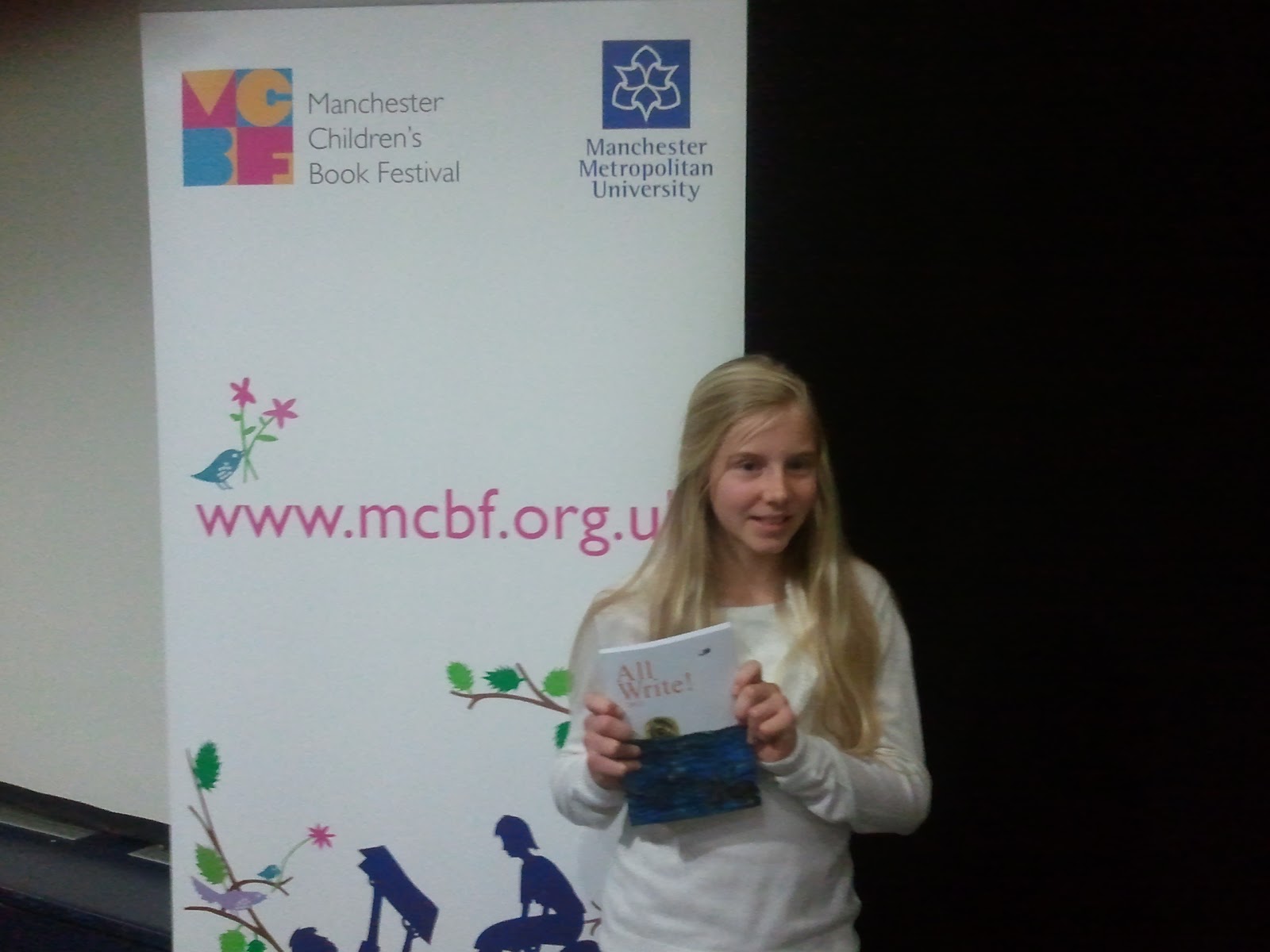
All Write is a creative writing competition that provides budding writers, aged between 9 and 12, with the opportunity to produce original and imaginative stories, the best of which are selected for publication in an anthology.  All Write has been publishing poems and stories by more than 600 young writers since 2005. 


Kay Tew, the competition’s organiser and director of the Manchester Children’s Book Festival, is really excited by this year’s collection, “there is a huge amount of young talent out there and the standard of competition entries just seems to get better and better each year.”

There was standing room only in the Z-arts’ studio as everyone squeezed in to hear Iris Feindt, Noel Fagan, Emily Birch and Helen Sea (graduates from the Manchester Writing School and authors of the very successful Animal Stew) announced this year’s winners. Judging by the many smiles that beamed around the room, it was clear that the children were delighted to have published authors celebrate their achievements.
Lydia Edwards
One winner was Lydia Edwards from the Royal Grammar School in Worcester, who received tremendous praise for her story The Journey. As she collected her award and her copy of the anthology, Lydia told us: “my story was inspired by a visit to my grandmother, who lives in Devon. It was a very long car journey because we got stuck in a horrendous traffic jam, but I decided to occupy the time by observing what was happening outside the window. I’m really grateful to that traffic jam because here I am, a year later, a published writer and a first prize-winner.” 

Safia Adia with big brother Yussuf
Yussuf Adia, from Ladybridge High School in Bolton won for his story, My Community, about a strange dystopian society where dogs play chess and babies have abnormal intelligence. Yussuf  “my favourite part has been winning. I wrote about things that I enjoy such as chess and dinosaurs.” Yusuf’s 7-year-old sister, Safia, looked on proudly as her big brother collected his award from the Manchester Writing School’s Iris Feindt. Not to be outshone, she informed us that she too will be entering in the future and plans to write about nature. 

Aoife Ronan from All Hallow’s Catholic High School in Macclesfield won with her poem, Dia Duitch, a celebration of the Gaelic language and culture. Aoife read her poem aloud to the audience, who responded with a thunderous applause.  
Klaudia Kawa
Another winner was Klaudia Kawa from St Peter’s High School in Gorton whose impressive poems, Nightfall and Leaves, evoke the work of Ezra Pound. She told us that it was “an honour to have my work published in the anthology, let alone to actually win. The competition has given me a lot of confidence and has inspired me to keep writing”. Klaudia’s English Teacher, Suzy Boardman, was very proud of her pupil; “I would like to congratulate all the winners but especially the twelve entrants from St. Peter's RC High School and our winner Klaudia. Well done!”  

Annabel Malkin
The 2012 All Write anthology features 40 of the best poems and stories from this year’s entrants. Among them is Annabel Malkin’s highly imaginative poem, Ten Things that a Mum would Never Say, which was inspired by a literacy lesson in school. Her poem provides an amusing and alternative take on parental discipline that will no doubt appeal to any child who wishes to get away with just about anything! Annabel from Queensgate Primary School in Bramhall was brimming with excitement, “I’ve really enjoyed today, it’s been absolutely great and I am so glad that I entered.” 

Mortan Fawns Williams
Mortan Fawns Williams, from Longdendale Community Language College in Hyde, who wrote a quirky and surreal story about rubber ducks taking over Manchester, was also delighted to have his story published and to discover that it was among first prize-winner, Lydia Edwards’, favourites.  “I really enjoyed writing my story because it allowed me to be imaginative,” he  said excitedly.

As the ceremony drew to a close, many children were already signing copies of their anthologies for friends and family, while others discussed their entries for next year. The 2012 All Write anthology is on sale now, priced at £5. You can purchase a copy from Amazon here.

Each of the winners receive an author visit to their school as well as the family tickets to Pinnochio, the Z-arts Christmas show. 
It certainly was a fabulous afternoon at the Z-arts, despite the rain and the cold, but it isn't over yet. We’re all off now to explore the Z-arts Mysteryland exhibition, a creative attempt to construct an adventure playground of the imagination for children and families. The exhibition is free and open to the public until Saturday 22ndDecember and visitors are also encouraged to bring along children’s books for the Christmas book exchange. 

For further details please visit http://www.z-arts.org/events/mystery-land/

For further details about the 2013 All WriteCompetition for 9-12 year olds, please visit the website http://www.mcbf.org.uk

Wednesday, 12 December 2012

Bringing Festive Cheer to Local Competition Winners

Words by Kate Butler


FOR the last few weeks, budding wordsmiths from across Greater Manchester have been plucking inspiration from historical characters and events, for the local-themed competition, Postcards from Christmases Past.

In a spin-off from the on-going competition, Postcards from the Past, a panel of judges from MMU sifted through sacks of entries covering a variety of festive themes, eventually agreeing on six lucky winners, who were announced on Friday.

Winners
John Herbert, 54 from Rochdale, Patricia Brock, 73 from Salford, Joseph Noble, 10 from St. John Fisher R.C Primary School, Christine Penney, 45 from Stockport, Noreen Dermody, 56 from Stretford and William West aged 62 from Chorlton, impressed the judges with their well-written, imaginative and touching messages, which are soon to be featured in their local newspapers.

From school history projects to keen postcard collectors, each individual had their own reasons for entering the competition. Each postcard uniquely encapsulated the Christmas festivities, be it through a moving story passed down through family generations, a celebration of the thriving hat industry in Denton in 1872, or whilst seeking shelter during a terrifying Christmas Eve bombing raid in 1940.

Postcards from the Past
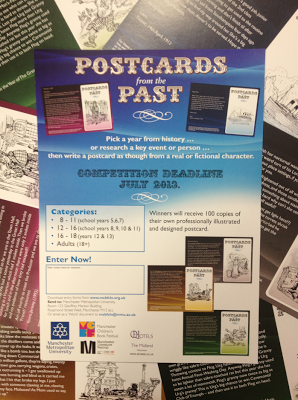
The winners will be automatically entered in the Postcards from the Past competition, a collaboration from the Manchester Children's Book Festival and the Manchester Literature Festival. It is free to enter and open to anyone from age 8 upwards. The competition invites participants to write a postcard from a real or fictional character, which can be from any chosen time in history.  Winners will get to have their postcards designed professionally and will receive 100 copies. The the deadline is 20thJuly 2013, so start writing!

For more information, please visit: www.mcln.org.uk/postcards_competition.php

Once a country girl, now a city dweller - Kate Butler is an avid adventurer, aspiring food and travel writer, equestrian enthusiast, coffee lover and pudding fiend. Kate currently studies a Masters in Multimedia Journalism at MMU.


Monday, 10 December 2012

Queen Victoria Reigns Once Again

MMU Balloon Debate, Tuesday 4th December, 5pm, Geoffrey Manton Building.

Words by Graham Murray, photograph by Jason Cooke


QUEEN Victoria emerged victorious in the inaugural Humanities Languages and Social Science Balloon Debate, which was hailed as a great success. She overcame strong challenges from the likes of William Beveridge, Jane Addams, Martin Luther King and Hugo Chavez amongst others on the evening of Tuesday 4th December 2012.

In a ‘standing room only’ event in a buzzing Geoffrey Manton Atrium seven debaters stepped up to deliver their five minute statements: Daniel Kennelly from History, Rodrigue Mauambu from Politics, Hermione St. John Spiggott from Criminology, Max Igbon representing Sociology, Luci O’Grady from Languages, Jonathan Orrill from Public Services and Sara Collinson from English. 

After an audience vote, three finalists were selected for the final round: Max Igbon’s Jane Addams, Jonathan Orrill’s William Beveridge and Daniel Kennelly’s Queen Victoria, to enter into a question and answer session with the audience. 

Suffrage, sickness and sewage 
Max, a local student from Chorlton, had put forward a strong argument for 1931 Nobel Peace Prize laureate Jane Addams, keen to stress her fight for women’s suffrage and changes in child labour laws. Jonathan’s increasingly confident performance remarked on the achievements of the 1942 Beveridge Report, most notably the NHS, and the five evils that Beveridge set out to destroy. Daniel was relaxed, confident and witty on stage, pointing to Victoria giving the vote to more than a million working class men, creation of London Sewage system and the achievements between her and Prime Minister Benjamin Disraeli. 

Tricky questions
The Q&A session provided some difficult questions for the finalists, including questions on Victoria’s role in the British Empire, what Sir Beveridge would think of today’s NHS, and why Addams was not a household name, despite her historical importance. All finalists navigated the question and answer stage with tact and good humour, clearly showing their enthusiasm and respect for their chosen figure. 

The three finalists all ended with a closing statement, with Max arguing that Addam’s 'impact had left a footprint today'. Daniel pointed to the fact Victoria is known around the world and oversaw the establishment of many civic systems and structures we still use today. Jonathan contended that Beveridge’s legacy was the most lasting, pointing to Victoria’s British Empire: "God Save the Queen? Yeah thanks for that," he said. 

'Embodiment of Britishness'
Daniel finished first, with Max coming a close second, and Jonathan third. Following the debate, all three said that despite the fact this was all their first time in debate, they would all love to do it again. The winner, Daniel Kennelly, remarked that he had chosen Queen Victoria as he saw her as the, “embodiment of Britishness”. 

Wonderful 
In an interview with Dr Janet Mather, who helped organise the event, she says: 


"It was wonderful to see so many people - staff and students - coming together for the     first ever Faculty event. I was immensely impressed by the quality of the champions' presentations, and also by the level of audience participation. In particular, it made me realise how proud we should be of our discipline. The champions had selected a wide range of people that had made extremely valuable contributions to the good of humanity - and all of them represented at least one aspect of humanities and social science. Without the kind of teaching carried out in the Faculty of Humanities, Languages and Social Science, these contributions would be undervalued and the world would be the poorer for it. May I express my admiration of the Dean, Dr Sharon Handley, too, as the first Dean to recognise the importance of engaging the staff and students throughout the Faculty in joint initiatives and being prepared to give so much support to this first one."

Thursday, 6 December 2012

Local Author’s Novel Is More Than Just Fantasy

Words by Neil Harrison.

Author A.J. Dalton with his latest book at Manchester Metropolitan University

One of Britain’s leading fantasy authors has paid a visit to Manchester Metropolitan University to discuss his latest novel and his on-going book tour.

 A. J. Dalton has lived in Sale since 2003 and has taught creative writing at both MMU and The University of Manchester. He is currently holding book signings across the region to promote his latest novel “Empire of the Saviours.”


The author describes the book as “an epic fantasy,” in which “a young boy unleashes pagan magic, before going on the run pursued by heroes, saints and saviours in an oppressive religious regime. It’s autobiographical, obviously” he adds, only half-jokingly.


He admits drawing upon his own youthful experiences in writing the book, which is set to be the first of a trilogy, saying “it has a ‘rites of passage’ element to it, which is a universal story.”

Despite coining the term ‘metaphysical fantasy’ to describe his own sub-genre, the author contests “at the end of the day, fantasy is fantasy. If it has a good human story it doesn’t matter what you call it.”


Released earlier this year, Empire of the Saviours has seen the writer at book signings “pretty much every week.” He believes it is part of his job as an author “to be able to talk to the customers about the genre and to be enthusiastic about fantasy.”  


A.J. Dalton will be signing copies of his book at Waterstones Warrington on Saturday 8th December. Empire of the Saviours is available for Kindle on Amazon. For more information visit ajdalton.eu


Historical figures set to face-off in debate

Tuesday, 4th December, Geoffrey Manton Building; Martin Luther King versus Hugo  Chavez in humanities event

Words by Graham Murray


EVER wondered what would happen if Martin Luther King went head-to-head with Hugo Chavez or Queen Victoria sparred with her contemporary Elizabeth Fry? The Humanities, Languages and Social Sciences Balloon debate could be your opportunity to find out. The debate is set to take place at 5pm on Tuesday, 4 December, in the atrium of the Geoffrey Manton building.

The debate is a celebration of the humanities as an academic field, demonstrating the diversity and ingenuity of historical figures of the humanities. Staff, students and alumni are needed to support their subject. The debate winner will receive an iPad and there will be refreshments, spot prizes and a raffle for audience members. 

Students from criminology, history, languages, philosophy, politics, public services and sociology will battle it out, representing an historical figure that best represents their field.

Audience vote

During the debate itself, each representative will be given five minutes to put forward their case as to why they should stay in the balloon. The audience, equipped with “Who Wants to be a Millionaire” style handsets, will then elect three figures to enter into the second round.

The second round will comprise of a question and answer session, with the audience given the opportunity to put forward questions to the speakers.  In the final round, speakers will make their final statements before handing over to the audience, who will decide the winner.

One of the organisers, Dr Janet Mather, Programme Leader BA (Hons) Politics, said: “I hope that it will show that the Faculty’s students have a keen awareness of the values of a Faculty of Humanities, Languages and Social Science, and the interconnectedness of the disciplines that make up that faculty”.

She added: “I am hoping that they will show that they can go beyond the concepts of their own particular discipline into the wider world of humanities and social science and that they can display the essential skills of communication, argument and presentation – again necessary in the world of increasing competitiveness in employment.”