Esmail Patel collaborates with Manchester Metropolitan University and The University of Manchester to aid D/deaf Learners with University Choices, Wednesday, 24th April, Geoffrey Manton Building, MMU
Words by Siobhán O'Toole
Words by Siobhán O'Toole

Esmail Patel, Director/CEO of DEAF (Deaf Education Advocacy Fellowship), joined forces this week with Manchester’s top universities to provide a day in which D/deaf learners could acquire information needed regarding their prospective university experiences, with support from Manchester’s Lord Mayor and Lady Mayoress.
Manchester Metropolitan University (MMU), The University of Manchester (UoM) and DEAF, came together to inspire and encourage D/deaf learners of the North West, and instil in them the belief that they can attend and enjoy university just as hearing people do. During the event, Hassan Naseer, a student at UoM, speaking on behalf of the deaf university experience, said, “we are exactly the same as hearing people, and have the same rights.” With that, he summarised the main ideology of the event: D/deaf learners are able to, and should, take as much from life as any other hearing person would.
Following registration in the Geoffrey Manton atrium, and the set-up of equipment (such as screens to show typed speech in order to ensure understanding), participants filled Lecture Theatre 6, eagerly anticipating the commencement of the event. UoM’s Laura Cragg enthusiastically introduced the day’s activities, while Dr. Sharon Handley, Dean of the Faculty of Humanities at MMU, conveyed her enthusiasm by thanking everyone for attending with hopes that the event would stimulate and inspire all attendees.
It was then Lord Mayor, Councillor Elaine Boyes’s turn to speak, whose presence alone, along with Lord Mayoress, Linda Geoghegan, was inspiration enough. Her speech incorporated the story of Dame Kathleen Mary Ollerenshaw, a British mathematician and politician who was Lord Mayor of Manchester from 1975 to 1976 and an advisor on educational matters to Margaret Thatcher's government in the 1980s. Ollerenshaw became almost completely deaf at the age of eight, and reached the wonderful age of one hundred last year.
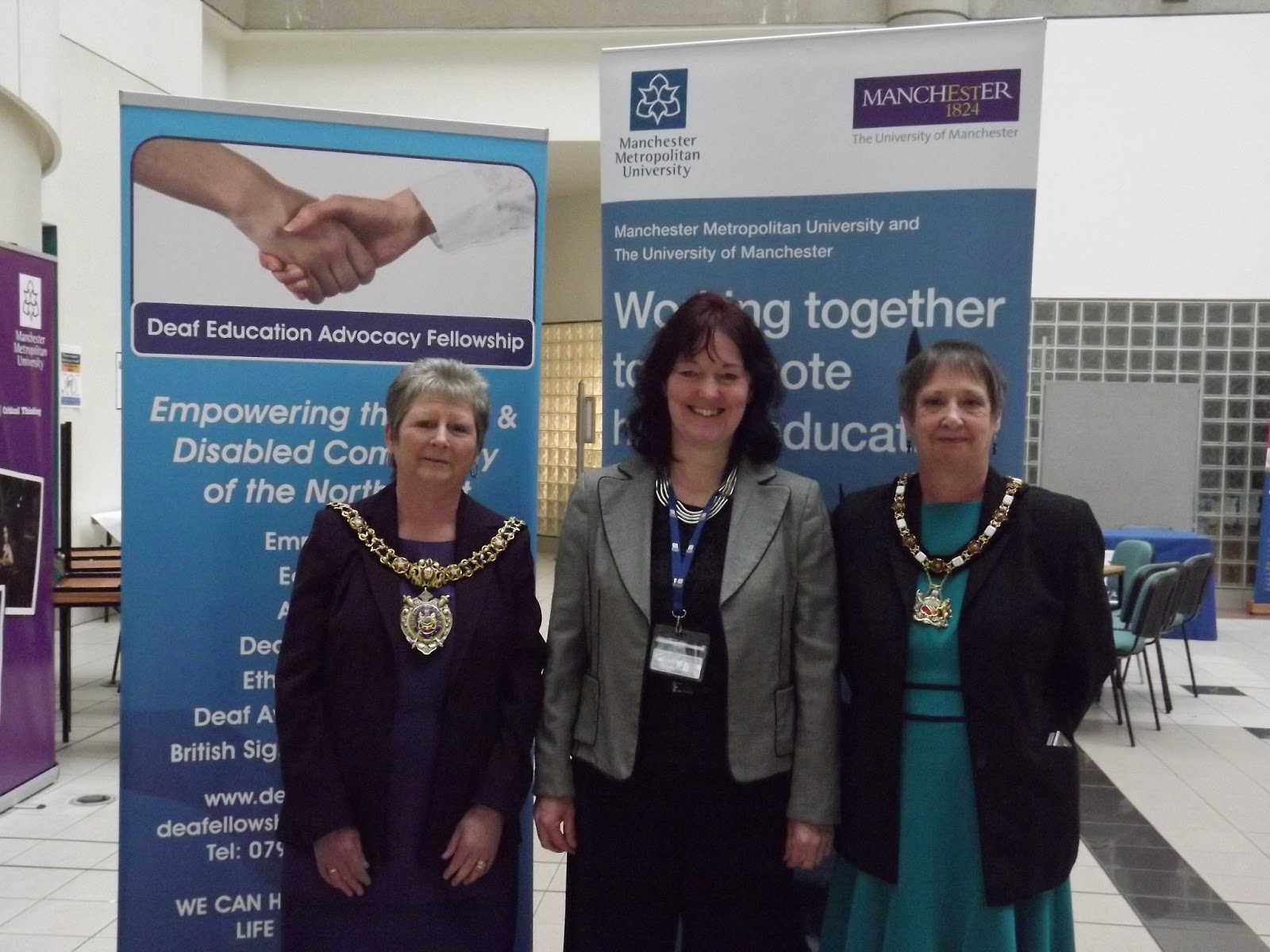 |
| From right to left: Lord Mayor, Councillor Elaine Boyes, Dr. Sharon Handley and Lord Mayoress, Linda Geoghegan |
Following her impairment, Ollerenshaw quickly learned to lip-read, as well as a multitude of other skills, including sports; representing England in the women’s ice-hockey team. At 19, Somerville College, Oxford, invited Ollerenshaw to an interview, and due to her advancement in lip-reading, no one at the university knew of her profound deafness until she had started the course. She left Somerville College with a first class degree.
The Lord Mayor utilised the life of Dame Ollerenshaw extremely effectively. Through details of her devotion to education and music, the whole room was affected, moving and inspiring D/deaf and hearing people alike, a unity felt throughout the entire day.
Before presentations on Student Finance and how to budget throughout university, Esmail thanked all involved in the organisation and support of this event, whilst also introducing his community-interest company, DEAF, and its aims:
“We were set up with one aim in mind, to empower and encourage confidence within the D/deaf community, encouraging D/deaf people to achieve their goals. We work primarily with deaf people, but also within the hearing community too, to campaign and spread awareness of the possibilities for all people within higher education.”
An important point of attention for Esmail was the diversity of the DEAF group today, commenting that, ‘it doesn’t matter whether you’re culturally or linguistically deaf or oral; we want this group to be all inclusive’, whilst also conveying the significance of being independent and how higher education facilitates this. I was extremely pleased when Esmail invited me to interview him in the near future. I look forward to hearing more about his story and primary role in creating and running the community-focused organisation.


After being educated on the difficult but worthwhile process of funding via Student Finance England, ambassadors from both universities directed tours of the two campuses. The ambassadors highlighted the most interesting and impressive buildings, such as MMU’s New Business School—a £75 million building which is one of the finest and most environmentally sustainable academic buildings in the UK—and UoM’s library, the largest non-legal deposit library in the UK and the third-largest academic library, after those of Oxford and Cambridge.
Next, guest speakers, Hassan Naseer and Farkandah Khan, introduced as D/deaf role models, tried to encourage participants not to be afraid, and fully take part in university life. Nasser, a current student of UoM, said that, “despite the problems that first year will present, such as new and frightening environments and people, it will get easier, and you will enjoy your experience.” Naseer, who is the first D/deaf student to study Electrical Engineering at UoM, also wanted to emphasise the level of support in place at universities, so that D/deaf people can learn and enjoy university like everyone else, and develop as independents.
Farkandah, a deaf, oral learner—and graduate from MMU—told her story of hard work, persistence, multiple jobs and time at MMU. Through ‘strong self-belief, commitment, determination and passion’, Farkandah achieved her first-class degree in travel and attained the accolade of Student of the Year. She later revealed her passion for helping the disabled in Manchester by improving their day-to-day experiences. Farkandah also shared her hopes of setting up a business that focuses on the disabled; organising events and partnerships to benefit the lives of those often ignored and forgotten in society.
Another inspirational D/deaf role model, whose work has significantly improved the lives of many, is Mahmudur Rahman. Despite many financial trials and tribulations over the past ten years, Rahman managed to set-up the Rochdale Rhinos Deaf Football Club and secured sponsorship from Esmail, through DEAF. Mahmudur, who left his boarding school for the deaf at 16, found it difficult to become involved in mainstream activities as, ‘society wasn’t as accepting of D/deaf people in those days’. He quickly became involved in D/deaf football, and despite many thinking that ‘deaf people couldn’t do this’, they played against mainstream teams and beat them over and over again. He said it was ‘a wonderful feeling to prove that we had talent, even playing against hearing people.’


Mahmudur proudly detailed the history of the team, and their initial local success against hearing police teams. They represented the only D/deaf team in the league and they still continue to defeat all other teams. They had local recognition, and a progressive sense of pride in both themselves and their achievements. Unfortunately, the team did not have sufficient funding to support the success of the team, and so, after years of struggle, Mahmudur eventually approached Esmail, who was happy to accept Mahmudur’s proposals and support the ‘Deaf Rhinos’ through the sponsorship of DEAF.
It was clear to see Mahmudur’s honour and pride in his team, especially after introducing his goalkeeper, Adhil Dad, ‘the star of the team; a great player’. Adhil said that being a part of the team is ‘fantastic, [and that] being a part of something that has endeavoured so hard to progress is just incredible. I’m so proud. The sky’s the limit for the team, and who knows where we will progress from here’. Their first game with the new sponsorship, and subsequent new kits, will be on 12thMay against last year’s champions, and after fervent requests that I attend, I very much look forward to cheering them on.
The day’s event was extremely successful. It proved to be significantly beneficial to both the hearing and D/deaf participants, who learned not only about the logistics of their prospective university experiences, but also that ‘deaf people can achieve, and should not be held back, ever’. Mahmudur represented this belief by saying:
“Race doesn’t matter, religion doesn’t matter, culture doesn’t matter, regardless of who you are, you have skills and interests, and so can take from life just as much as anyone else’.
The collaboration between MMU, UoM and Esmail Patel and DEAF was clearly a success, evident in the participants’ positive acceptance of ideas regarding the potential of D/deaf individuals, the multitude of opportunities open to them, and the event’s encouragement of participants to refuse and banish perceptions of inferiority.
Siobhan studies English Literature at Manchester Metropolitan and is an inspiring writer, hopeless optimist and romantic, and a complete technophobe. Follow Siobhan on Twitter @smo_07
Siobhan studies English Literature at Manchester Metropolitan and is an inspiring writer, hopeless optimist and romantic, and a complete technophobe. Follow Siobhan on Twitter @smo_07


