Friday, 3 May 2013

A Celebration for Collaborations


Esmail Patel collaborates with Manchester Metropolitan University and The University of Manchester to aid D/deaf Learners with University Choices, Wednesday, 24th April, Geoffrey Manton Building, MMU

Words by Siobhán O'Toole


Esmail Patel, Director/CEO of DEAF (Deaf Education Advocacy Fellowship), joined forces this week with Manchester’s top universities to provide a day in which D/deaf learners could acquire information needed regarding their prospective university experiences, with support from Manchester’s Lord Mayor and Lady Mayoress.

Manchester Metropolitan University (MMU), The University of Manchester (UoM) and DEAF, came together to inspire and encourage D/deaf learners of the North West, and instil in them the belief that they can attend and enjoy university just as hearing people do. During the event, Hassan Naseer, a student at UoM, speaking on behalf of the deaf university experience, said, “we are exactly the same as hearing people, and have the same rights.” With that, he summarised the main ideology of the event: D/deaf learners are able to, and should, take as much from life as any other hearing person would.

Following registration in the Geoffrey Manton atrium, and the set-up of equipment (such as screens to show typed speech in order to ensure understanding), participants filled Lecture Theatre 6, eagerly anticipating the commencement of the event. UoM’s Laura Cragg enthusiastically introduced the day’s activities, while Dr. Sharon Handley, Dean of the Faculty of Humanities at MMU, conveyed her enthusiasm by thanking everyone for attending with hopes that the event would stimulate and inspire all attendees.

It was then Lord Mayor, Councillor Elaine Boyes’s turn to speak, whose presence alone, along with Lord Mayoress, Linda Geoghegan, was inspiration enough. Her speech incorporated the story of Dame Kathleen Mary Ollerenshaw, a British mathematician and politician who was Lord Mayor of Manchester from 1975 to 1976 and an advisor on educational matters to Margaret Thatcher's government in the 1980s. Ollerenshaw became almost completely deaf at the age of eight, and reached the wonderful age of one hundred last year.
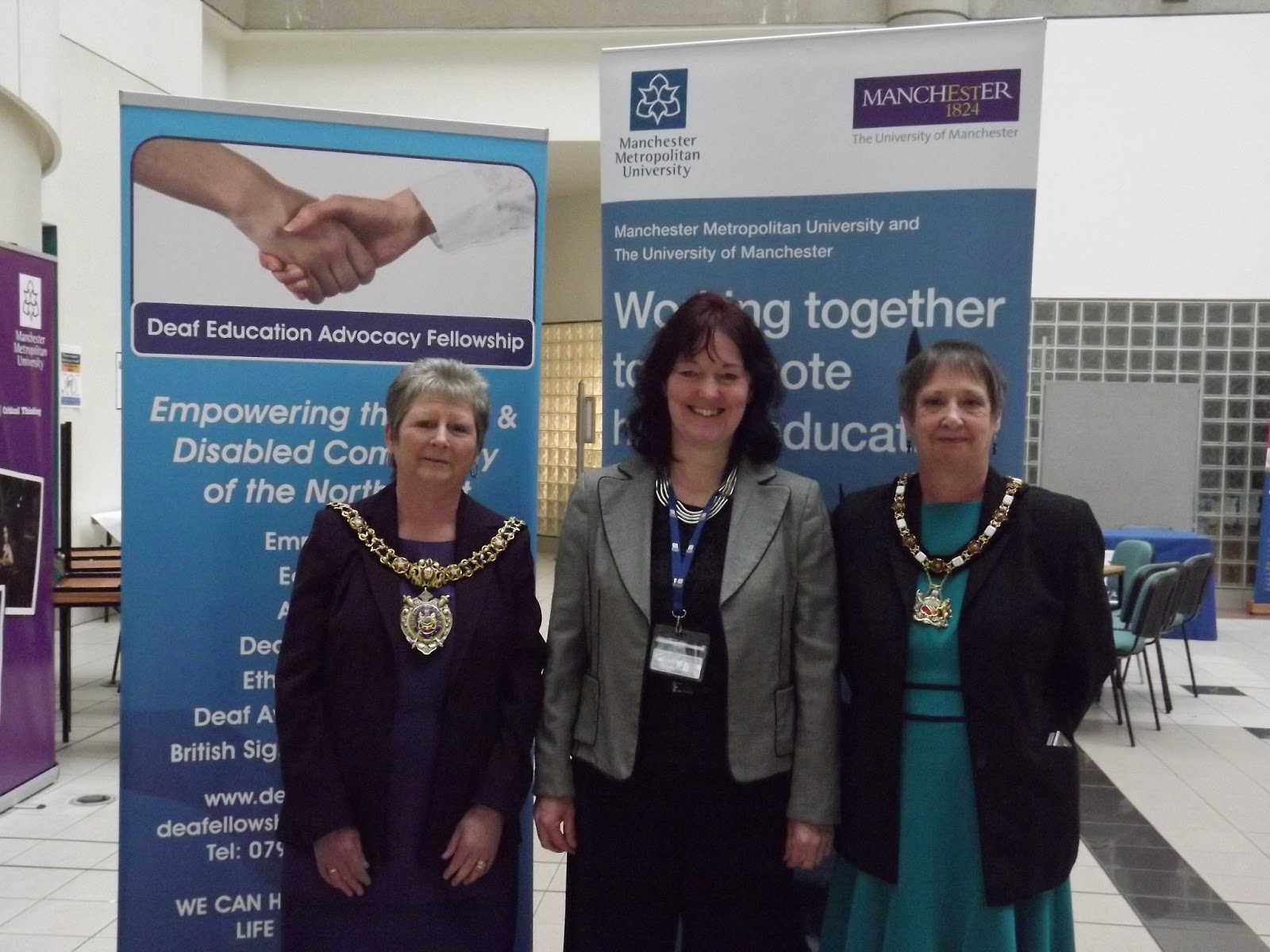

From right to left: Lord Mayor, Councillor Elaine Boyes,
Dr. Sharon Handley and 
Lord Mayoress, Linda Geoghegan
Following her impairment, Ollerenshaw quickly learned to lip-read, as well as a multitude of other skills, including sports; representing England in the women’s ice-hockey team. At 19, Somerville College, Oxford, invited Ollerenshaw to an interview, and due to her advancement in lip-reading, no one at the university knew of her profound deafness until she had started the course. She left Somerville College with a first class degree.

The Lord Mayor utilised the life of Dame Ollerenshaw extremely effectively. Through details of her devotion to education and music, the whole room was affected, moving and inspiring D/deaf and hearing people alike, a unity felt throughout the entire day.

Before presentations on Student Finance and how to budget throughout university, Esmail thanked all involved in the organisation and support of this event, whilst also introducing his community-interest company, DEAF, and its aims:

“We were set up with one aim in mind, to empower and encourage confidence within the D/deaf community, encouraging D/deaf people to achieve their goals. We work primarily with deaf people, but also within the hearing community too, to campaign and spread awareness of the possibilities for all people within higher education.”

An important point of attention for Esmail was the diversity of the DEAF group today, commenting that, ‘it doesn’t matter whether you’re culturally or linguistically deaf or oral; we want this group to be all inclusive’, whilst also conveying the significance of being independent and how higher education facilitates this. I was extremely pleased when Esmail invited me to interview him in the near future. I look forward to hearing more about his story and primary role in creating and running the community-focused organisation.


After being educated on the difficult but worthwhile process of funding via Student Finance England, ambassadors from both universities directed tours of the two campuses. The ambassadors highlighted the most interesting and impressive buildings, such as MMU’s New Business School—a £75 million building which is one of the finest and most environmentally sustainable academic buildings in the UK—and UoM’s library, the largest non-legal deposit library in the UK and the third-largest academic library, after those of Oxford and Cambridge.

Next, guest speakers, Hassan Naseer and Farkandah Khan, introduced as D/deaf role models, tried to encourage participants not to be afraid, and fully take part in university life.  Nasser, a current student of UoM, said that, “despite the problems that first year will present, such as new and frightening environments and people, it will get easier, and you will enjoy your experience.” Naseer, who is the first D/deaf student to study Electrical Engineering at UoM, also wanted to emphasise the level of support in place at universities, so that D/deaf people can learn and enjoy university like everyone else, and develop as independents. 

Farkandah, a deaf, oral learner—and graduate from MMU—told her story of hard work, persistence, multiple jobs and time at MMU. Through ‘strong self-belief, commitment, determination and passion’, Farkandah achieved her first-class degree in travel and attained the accolade of Student of the Year. She later revealed her passion for helping the disabled in Manchester by improving their day-to-day experiences. Farkandah also shared her hopes of setting up a business that focuses on the disabled; organising events and partnerships to benefit the lives of those often ignored and forgotten in society.

Another inspirational D/deaf role model, whose work has significantly improved the lives of many, is Mahmudur Rahman. Despite many financial trials and tribulations over the past ten years, Rahman managed to set-up the Rochdale Rhinos Deaf Football Club and secured sponsorship from Esmail, through DEAF. Mahmudur, who left his boarding school for the deaf at 16, found it difficult to become involved in mainstream activities as, ‘society wasn’t as accepting of D/deaf people in those days’. He quickly became involved in D/deaf football, and despite many thinking that ‘deaf people couldn’t do this’, they played against mainstream teams and beat them over and over again. He said it was ‘a wonderful feeling to prove that we had talent, even playing against hearing people.’


Mahmudur proudly detailed the history of the team, and their initial local success against hearing police teams. They represented the only D/deaf team in the league and they still continue to defeat all other teams. They had local recognition, and a progressive sense of pride in both themselves and their achievements. Unfortunately, the team did not have sufficient funding to support the success of the team, and so, after years of struggle, Mahmudur eventually approached Esmail, who was happy to accept Mahmudur’s proposals and support the ‘Deaf Rhinos’ through the sponsorship of DEAF.

It was clear to see Mahmudur’s honour and pride in his team, especially after introducing his goalkeeper, Adhil Dad, ‘the star of the team; a great player’. Adhil said that being a part of the team is ‘fantastic, [and that] being a part of something that has endeavoured so hard to progress is just incredible. I’m so proud. The sky’s the limit for the team, and who knows where we will progress from here’. Their first game with the new sponsorship, and subsequent new kits, will be on 12thMay against last year’s champions, and after fervent requests that I attend, I very much look forward to cheering them on.

The day’s event was extremely successful. It proved to be significantly beneficial to both the hearing and D/deaf participants, who learned not only about the logistics of their prospective university experiences, but also that ‘deaf people can achieve, and should not be held back, ever’. Mahmudur represented this belief by saying:

“Race doesn’t matter, religion doesn’t matter, culture doesn’t matter, regardless of who you are, you have skills and interests, and so can take from life just as much as anyone else’.

The collaboration between MMU, UoM and Esmail Patel and DEAF was clearly a success, evident in the participants’ positive acceptance of ideas regarding the potential of D/deaf individuals, the multitude of opportunities open to them, and the event’s encouragement of participants to refuse and banish perceptions of inferiority. 

Siobhan studies English Literature at Manchester Metropolitan and is an inspiring writer, hopeless optimist and romantic, and a complete technophobe. Follow Siobhan on Twitter @smo_07

Tuesday, 30 April 2013

All Nodding for 'Nod'.


Sleepless in the Shortlist: MMU Alumnus, Adrian Barnes, nominated for Arthur C. Clarke Award

Words by Neil Harrison


A graduate of an online Master's Degree course run by MMU has been nominated for a prestigious science fiction literary award. Adrian Barnes, who received an MA in Creative Writing, has seen his debut novel, Nod, shortlisted for the 2013 Arthur C. Clarke Award, an annual British event which seeks out the best science fiction novel of the year.

The Canadian based writer, who was born in Blackpool but moved to Canada when he was five years old, is in Britain for only a short time in order to publicise the novel, ahead of attending the awards ceremony on May 1st. Humanity Hallows caught up with him in West Yorkshire, where his publishing company, Bluemoose Books, is based.

Asked whether he was a writer before receiving his Master's Degree in 2008, Adrian laughs,

"Not in the 'published, having-a-book-out kind of way!' I've always written, and always been an avid reader but the reason I took the [MA] course was to become a teacher. I needed that qualification in order to do that and in Canada, with a family and other commitments, it can be quite difficult to do, so the online course made sense."

As part of the MA, students are required to have completed a novel and in Adrian's case, that novel was Nod. When asked about his approach to writing, the author, who clearly has more than one string to his bow--being a teacher of creative writing and also the proprietor of the Rossland Telegraph media outlet-- says,

"I write fairly quickly, I can have [a first draft] written in around three weeks ... I'm bragging a little there ... but I re-write forever."

The novel itself is an exploration of the consequences of lack of sleep on a mass scale. As well as the award nomination, it has gone on to receive critical acclaim, with The Guardiandescribing the book as "outstanding." The premise seems inspired in its simplicity, so just how did it occur to him?

Adrian Barnes
"I often have difficulty sleeping myself, right at the moment, for instance, due to the travelling. I think what interests me most of all is the way that tiredness, loss of sleep, can begin to affect the strongest relationships, even in a family setting. There's a very thin veneer there when you begin to think about it; how would society continue to function? They say you can only survive for six days without sleep before going mad."

Where, then, does Nod sit within the science fiction genre? Adrian largely dismisses the notion that the book is his journey down the much wandered 'zombie' path. It is, however, an apocalyptic scenario set “just a little into the future," says the writer.

"I would describe the book as being in that sub-genre of science fiction, speculative fiction. It's very much a ‘what would happen if...’ kind of scenario, in much the same way that Cormack McCarthy's The Road is, for instance."

Concurrent to the theme of insomnia, there is an etymological aspect to the book, hinted at in the title itself. The Land of Nod, whilstbeing an almost comforting notion for most who aspire to drift off to it, is in actual fact the biblical place of exiled torment for Cain—banished for the crime of slaying his brother Abel—which is described in The Book of Genesis in the Old Testament. Not such a comforting notion. Adrian says,

"I am fascinated with medieval words and their meanings, which have often come to take on different forms through the centuries. The principle character is an etymologist and the dual aspects of certain words, certain notions, begin to take shape and bear relevance as the events of the story unfold."

As well as promoting Nod, Adrian is currently working on other projects; both fiction and non-fiction, and there has been interest from movie companies in the United States, eager to see his debut novel adapted for the big screen. Clearly, Adrian Barnes is a name to look out for in the future.

The 2013 Arthur C. Clarke Award winner is announced on May 1st.

Nod is available now, published by Bluemoose Books.

Neil Harrison is studying Social History at Manchester Metropolitan University. He is an aspiring journalist and a terrible guitar player. Read his blog LooseRiver and follow him on Twitter @LooseRiver

Monday, 29 April 2013

'Our Country's Good' and so was this play!


Our Country's Good by Timberlake Wertenbaker, Directed by Chris Honer, Thursday, 25th April, Capitol Theatre, MMU

Words and photographs by Kevin Danson


My third time at MMU's Capitol Theatre and once again it leaves me more than satisfied with everything about the performance. The setting, seating and sound adds to the experience of this intense, yet comic play. 

Our Country's Good is a play about the first penal colony in Australia. On the shores of New South Wales in the late eighteenth century, the story concerns a group of convicts and Royal Marines. After noting how putting on a performance might arouse ‘pity and fear’ from the cast and audience of convicts, the Governor of the colony believes the convicts might reach redemption by putting on a show. Over the course of rehearsals of this play within a play, authority within the colony is challenged, relationships evolve, while others dissolve, taking with them communal justice and individual sanity. 

These third-year actors are incredibly talented. The play intentionally has a small cast to its required number of characters, allowing (or forcing) the actors to display their range of skill in one performance, sometimes even in one scene. This bumps up the respect I already have for these artists. Each character they incorporate bears no resemblance to the subsequent one. I know this is expected, but I can imagine how difficult it must be to nail an accent or physical trait every time they make their transformation. 
Left to right: Holly Fishman Crook, 
Simon Jenkins 

There is not one actor I can comment negatively upon, thankfully. MMU’s current third years make a strong ensemble cast. Instead of talking you through the play as a whole, I would like to mention a few actors individually. This is mainly due to the characters ascribed to them, as well as the personal spin they added to their representations.

Rory Thomas’ main character is the comedic Robert Sideway, a role that seems to have been written exactly for him. I follow his absurd, overly dramatic mannerisms as I follow the words of the play—intently. Though we witness his lashings at the start of the play, providing him with the audience’s sympathy, Rory and Robert carry with them a lightheartedness that softens some of the more intense scenes.

Hayley Gowland has been in all three of the plays I’ve seen here, and I have thoroughly enjoyed all of her performances. Hayley’s character; the intimidating convict of Liz Morden, is the main role she plays in this production. Her best scenes are the comedy scenes: Liz awkwardly attempts an imitation of a lady’s upper-class demeanor and hurls her learnt lines for the play at the Lieutenant without pause or necessary emotion. I wait for a stutter or a stumble, but instead I am left with a strong will to applaud.

Another two actors who make the play, for me, are Assad Zaman and Max Henry-Walsh. Assad executes swift changes from a mumbling Scottish Captain, Jemmy Campbell, to the convict, John Ascott, and the suffering midshipman, Harry Brewer. While his mutterings of a Rab C. Nesbitt kind draws in frequent chuckles from the audience, the psychological deterioration of the haunted and tormented Harry make me feel like a spy, as if I am on the shore with him close by, watching as he gradually breaks down. I have seen Assad play a small role in one of the sketches in, Tonight at 7:30 (originally Tonight at 8:30), which did not show his range of acting. I feel like this performance has definitely shown his capability as a professional actor.
Left to right: Max Henry-Walsh, Simon Jenkins 

Like Assad, I have seen Max in a smaller role in, Tonight at 7:30 (originally Tonight at 8:30). Unable to discern his true abilities beforehand, Our Country’s Good has given room for Max to demonstrate his skills by portraying two extremely different characters; Ketch Freeman, an Irishman transported to the colony for killing a sailor, and the Scottish Major Robbie Ross. While the cheeky chappie of Ketch was pleasing to watch, making me want to go for a country stroll and maybe jump in the air and kick my heels together, the Major had me seething. I was once told that if I feel hatred for a character who is meant to be bad, then the actor is doing good work. Kudos to Max! He had me folding my arms, clenching my fists and shaking my head. His accents were infallible as was the mutation between his characters.

In addition to the cast, another part I enjoy is the intertheatricality. References are made to the way in which inequality within the colony—between the convicts and the Royal Marines—is compared to the inequality Socrates expressed in his plays, and was therefore punished for by death. Also present are the undertones of Shakespeare’s Hamlet; a play within a play, these actors acting as actors, and the haunting ghost. My education seems to be paying off.
Left to right: Rory Thomas, Holly Fishman Crook, Hayley Gowland, 
Simon Jenkins, Mabel Wright 

This group of third years is tight and the hours they put into rehearsals obviously pays off. Each one is in the production because of their talents, and although not all have been mentioned individually this time, I’m sure I will get round to bolstering their talents soon.

The Manchester School of Theatre is my new local. These students put on a show well worth watching. Although I was unable (due to periods of lethargy) to follow up the previous performances with a review, the next two; Brontë, (15th – 18th May) and, A Bright Room Call Day, (5th – 8th June), will be.


Students get tickets for £2.50 on Thursdays! 


Kevin Danson is an English Literature student at MMU who likes to share his ramblings. Read his blog Pebbleddash and follow him on Twitter @pebbleddash