Thursday, 25 April 2013

UNESCO Chair of Human Rights Fights Case for Humanities.

'Human Rights, Humanities and Higher Education': Jean-Paul Lehners, Geoffrey Manton Building, MMU, Monday, 22nd April

Words by Neil Harrison

Photograph by wwwen.uni.lu

This week's IHSSRresearch seminar sees MMU play host to the first UNESCO Chair of Human Rights and recently retired Professor of Global History at the University of Luxembourg, Jean-Paul Lehners. Professor Lehners, who is a member of the Council of Europe and regularly advises governments on human rights issues, is, during his first visit to the region, at the university to deliver a lecture entitled 'Human Rights, Humanities and Higher Education.'

Professor Lehner begins by explaining the current state of European and global policy regarding human rights and education. He explains:

“In December 2011, the general assembly of the United Nations adopted the Declaration on the Right to Human Rights Education. The text contains a number of concepts: opportunities, spirit of participation, inclusion, responsibility, equality, freedom of expression, the right to information and the prevention of human rights violations.”

“Human rights, education and training encompasses ... education about human rights, which includes: providing knowledge and understanding of human rights norms and principles, the values that underpin them and the mechanisms for their protection. Education through human rights including learning and teaching in a way that respects the rights of both educators ... and learners. And education for human rights, which includes empowerment of persons to enjoy and exercise their rights and to respect and uphold the rights of others.”

Culminating in a plea for higher education institutions to include explicit human rights policies within their respective mission statements, Professor Lehners cites the 2009 Venice Statement which was partly organised by UNESCO, stating:

“A human rights based approach requires that science and its applications are consistent with fundamental human rights principle. While the enjoyment of academic freedom requires the autonomy of higher education institutions, higher education as a public good ... must be a matter of responsibility and economic support of all governments.”

Therefore, it is clear the council believes that the burden of responsibility for the implementation and upholding of these cited principles should lie, not simply with the academic institutions, but also with the state.

Professor Lehners concludes the introductory section of his lecture with some recommendations for universities in terms of adopting what he describes as “a human rights dimension” when constructing their strategic literature.

“It is already a progress[ion] if some rights are mentioned, for example, freedom of expression. However, a better approach, of course, would be the [explicit] inclusion of human rights in codes of conduct, in mission statements and plans of action.”

From here he believes that universities can make the human rights dimension ‘transversal,’ and ensure it concerns an institution's ‘learning, research, management, and service to society,’ cementing the involvement of teachers, students and staff and “mainstreaming” human rights.

Here the professor begins to focus his discussion on the ‘added value that the humanities can bring to the study of human rights.’ With an emphasis on his personal academic field, namely History, he delves into a historiography of human rights, beginning:

“Research on the concept of human rights has long been dominated by lawyers. Historians until the recent period have made only a few contributions to the subject. Is this linked to the fact that a historical approach to human rights is questionable?”

He acknowledges many of the arguments against the validity of historical research on the subject of human rights, simultaneously countering each with his personal view that this type of research is valuable.

“Is it the aim of history to legitimize [contemporary human rights] through a linear causality? It is the historian's duty ... to identify crucial turning points. Without history I think misinterpretations would be the order of the day.”

“Throughout history,” he continues, “there have been many barriers and limitations on the notion of human rights. From the transplantation of western ideology into different global cultures, to the linguistic and gender limitations which exist to this day, the French catch-all term ‘Droits de l'homme’ (Rights of Man) being a prime example of gender inequality.”

From here we are taken on a journey from antiquity, via the Magna Carta, The French Revolution, the ideologies of Jeremy Bentham and Karl Marx and the long shadow cast by both 20th century World Wars and particularly the 1948 Universal Declaration of human rights, which Professor Lehners explains, came about as a direct consequence of the suffering inflicted and experienced during World War II. This phenomenon, he emphasizes, is not without precedent. Human rights declarations appear following both the American and French Revolutions and have traditionally been seen as a reaction to ‘painful experience.’ Furthermore, each author of a particular human rights text is influenced by those that have gone before, which makes the understanding of historical human rights legislation all the more important.

Guiding his audience in the direction of the work of American historian, Lynn Hunt,  he offers her interpretation of the notion:

“Human rights require three interlocking points: Natural;inherent in human beings, Equal; the same for everyone and Universal; applicable everywhere. They will become meaningful when they gain political content. [Hunt's] interpretation induces the paradox of self-evidence: If human rights are self-evident, natural, why do they need to be declared?”

This direction necessarily leads to the philosophical aspects of the debate regarding human dignity, which Professor Lehners duly acknowledges, citing works by Adorno, and more recently, Ruth Macklin. He continues with an unabashed bias towards history, exploring how it came to be that human rights study in the field has gained currency over the last few decades.

“So, what has changed in the human rights discourse in the last years? One new factor is that historians have entered into the debate.”

Lehners discusses at length the work of, again, Lynn Hunt, particularly her book Inventing Human Rights and also that of her contemporary, Samuel Moyn, and his The Last Utopia. According to Moyn, ‘human rights made sense to a large part of the population only after 1968.’ In support of this, Professor Lehners offers examples such as the protests following the Vietnam War, dissidence in Eastern Europe and the peace movement.

The essence of the argument put forth by Jean-Paul Lehners in this lecture, therefore, is that the nature of the discourse surrounding human rights is extremely complex. To highlight this he invokes examples as wide-ranging as court cases involving dwarf-tossing, the argument surrounding the right to wear a bhurka and the rights of a pregnant woman seeking an abortion over those of an unborn child. At every tangent of the debate lies a potential philosophical, legal and political wrangle. The lecture is littered with difficult questions; when discussing the 1948 declaration's 'protection of families' aspect, Lehner immediately asks, “who decides what constitutes a family? Is a family the same now as it was in 1948?” The abstract nature of the concept of human dignity is dealt with in both a philosophical and legal context and the speaker's insights are at once illuminating and perplexing. There are no clear answers here.

One thing that does become clear is the professor's determination to see universities, and specifically the humanities subjects, playing a central role in the future debate:

“In order to understand human rights, we have to contextualise them. Humanities and social sciences have an important part in this process. Human rights...are meant to shift between texts and reality. What can I do with human rights declarations if I am poor and too weak to defend myself? It is…of utmost importance within the context of the financial and economic crisis today.”

“Human rights are the result of the learning process and they respond to experiences of injustice and suffering. Narratives based on publicly articulated experiences of injustice have to be added to the narratives based on written documents.”

It is with this task he charges his fellow humanities scholars.

For information about upcoming research seminars and lectures please visit IHSSR's website hssr.mmu.ac.uk/

Neil Harrison is studying Social History at Manchester Metropolitan University. He is an aspiring journalist and a terrible guitar player. Read his blog LooseRiver and follow him on Twitter @LooseRiver


Tuesday, 23 April 2013

Celebrate The Need of Humanities In The 21st Century

Do Humanities Matter in the 21st Century? Neil Harrison, Richard Reed, and Sascha Wilts all agree with a resounding and resonating… YES! 

Words by Siobhán O'Toole

Left to right: Richard Reed, Neil Harrison & Sascha Wilts
Today’s award ceremony celebrated three deserving winners who all entered wonderfully diverse pieces in reaction to the above question earlier in the year. 

The competition, launched by MMU’s Humanities Faculty, asked students from all subject areas to enter either an essay of 1000 words, or a three-minute video, which responded to the question: ‘Do Humanities Matter in the 21st century?’ The competition brief encouraged entrants to consider Humanities in regards to new media, new messages, new meanings, values and attitudes, culture, and the rising significance of the digital age. 

Dr. Jess Edwards, Head of the English Department, kindly began proceedings by introducing the significance of such a question, and reminding us that the asking of it today is not a new thought, but one that has occurred innumerable times before, notably so in dark periods of austerity. Such periods encourage societies to defend the study of Mathematics, Sciences, and subjects with clear economic benefits, but question the study of subjects such as Philosophy, Politics, History, English, Sociology, and so on. These are seen as subjects with indistinct economic benefits, despite their immeasurable influence regarding our development and improvement as people and communities. 

To convey this, Jess discussed the role of Patricia Waugh (literary critic and professor of English Literature at Durham University), and her thoughts on this significant question—one notable opinion being that such enquiries regarding the value of Humanities, in no way affect the creative output of a society. On the contrary, Waugh said that it is in times of deep austerity that the greatest works arise. 

Jess supported such views by sharing that, despite national decreases in applications to study Humanities subjects, this is not the case at MMU, which remains resilient and receives encouraging numbers of applications every year. Before introducing the three winners, and presenting them with their prizes, Jess conveyed his pride in his position as Head of the English Department, and ‘defending the role of Humanities every day’. He noted that the work entered by the three winners was, ‘marvellous, passionate, articulate and persuasive’, whilst also presenting a summary of the judges’ views on the entries as, ‘very different in style, approach and message. However, all entries were equally as convincing and stimulating as the next.’ 

It was then time for the presentation of prizes, something highly anticipated by all three winners, due to the fabulous nature of each award. Firstly, Jess presented Sascha Wilts, a German Erasmus student of English, with third prize of a £25 Amazon voucher for his essay: ‘Do Humanities matter in the 21st Century? – A Plea for Humanities’. Secondly, Jess awarded Richard Reed, a combined honours student of International Politics and Marketing, with second prize of a £100 Amazon voucher for his film, entitled with the competition question. Lastly, Neil Harrison, student of History and fellow Student Press Officer, was presented with first prize; a brand spanking new iPad, for his essay: ‘Responding To Threats: ‘Do Humanities Matter in the 21st century?’ The iPad, he said, would go straight to his children, who would know how to use it better than him due to using them frequently at their school. 

Richard’s entry was the only one in video format, all others were essays, and so I automatically assumed that he was adept at filmmaking, to which he replied, ‘it’s something that I’m interested in, but not very good at’, a comment that many academics present would disagree with. 

Of his inspiration, Richard said that a major factor was science and technology, noting that, ‘I come from the 80s, before mobile phones, and I remember that everyone got on and survived very easily without all of these new technologies. They have taken over in a sense, and they are not necessities’. In addition, he explained his love for the Humanities in regards to how they permit you to speak and understand the world in which we live: ‘I love different opinions and learning from mistakes, otherwise how do we grow and develop?’ 

Whilst the room of academics and staff mingled, drank coffee and enjoyed nibbles, Neil added, ‘all Humanities subjects are important, they all have a role to play, and I tried my best to convey the importance of all subjects; Politics, History, Philosophy, English’. This he certainly did, his essay exuded a love of the Humanities and a passionate defence of their inclusion in Education today. 

Today’s event was extremely touching and rousing. In a society where many deem the study of subjects such as my own (English) as rather pointless, it is extremely encouraging to see that there are many who, not only value the study of the Humanities highly, but regard it as a vital component to society. These people silence those who question our studies; the friends who interrogate your future, the taxi drivers who ask, ‘but you speak English beautifully dear, why study it?!’, and the masses who assume that your vocation must be to teach. Discussions similar to the one I was lucky enough to attend today, silence such negativity and closed-mindedness. 


Reviews:

Do Humanities Matter in the 21st Century? - A Plea for Humanities
An Essay by Sascha Wilts


Sascha Wilts’ essay, which examines and argues for the value of Humanities in the 21st Century, is an extremely passionate and convincing piece that provides substantial reasoning for his views. He begins by outlining that, for him, Humanities is questioned due to a modern focus upon statistical results, rather than the critical thinking and analysis that exposure to literature, history, philosophy and the arts provides.

However, for Sascha, in order to change the world and its problems, we must understand it, something only achieved through constant examination and reflection upon our society. In order for society to develop, we must consider others and the differences within society, so that we welcome and celebrate such differences. Only when people are open to communication, reflection, critical thinking and the welcoming of otherness, will society truly flourish and develop. His quote from Einstein says it all, ‘Learn from yesterday, live for today, hope for tomorrow. The important thing is not to stop questioning.’

Do Humanities Matter in the 21st Century?
A Film by Richard Reed


Richard’s argument for the value of Humanities in society today, begins with an extract from Shakespeare’s Hamlet and his ‘to be or not to be’ monologue. He provides a fitting example of the arts and literature, and their value when contemplating the development and change of our world, ‘and by dream we say mend the heart-ache’, the heartache of society’s lost connection with its true needs. In order to convey his ideas, Richard does so effectively through the attention-grabbing form of video, with informative, and sometimes amusing, discussion of his thoughts. The first of which, is the importance of studying Humanities in reaction to the development of market driven science, and a move away from peace.

With images of wartime cemeteries and poppies, Richard discusses the need for Humanities when taking from the past, and learning from its mistakes. Overall, he argues that in order for an equality of Education, communication in Politics, cultural balance, equality of market forces, understanding of science vs. nature, and development of imagination, love and understanding, we must embrace the study of Humanities. His argument is flawless, intriguing, stimulating, well informed and its format highlights that the Humanities can work in harmony with the digital world.

Responding to Threats: Do Humanities Matter in the 21st Century?
An Essay Neil Harrison


Neil Harrison’s piece on the value of Humanities, in regards to society’s response to threats, provides fervent, insightful and fresh ideas about a day which has been covered innumerable times on a global scale. He analyses the ways in which society responded to 9/11 as conveyable of society’s need of Humanities in order to develop, and most importantly, react against and alter atrocities in the world that need such an outcry from such large numbers of people. Atrocities such as malnutrition, economic crises, consumerism, all of which affect societies on a global scale, and could be altered and banished purely by awareness and the will to change, which for Neil, originates from Humanities: history, the arts, literature and politics. In Neil’s own words, ‘we must understand what has happened in the story so far, and we must communicate our messages creatively and effectively. In other words, we need Humanities.’

Siobhan studies English Literature at Manchester Metropolitan and is an inspiring writer, hopeless optimist and romantic, and a complete technophobe. Follow Siobhan on Twitter @smo_07

Monday, 22 April 2013

Sue Stern: The Trials, Tribulations and Triumphs of Becoming a Successful Writer


Student Press Officer, Siobhan O’Toole, talks to Didsbury’s Sue Stern—published novelist, poet, and children’s author, about her influences, journey as a developing writer, heritage, and joy of becoming self-published.

Words by Siobhán O'Toole


On approaching the lovely Didsbury home of Sue Stern today, I could not help but feel nervous excitement after reading and enjoying many of her poems, short stories, and extracts from various novels, instilling a naïve sense of stardom in my expectation of her. However, as soon as Sue opened her door, this child-like nervousness evaporated, leaving only burning curiosity and interest concerning details of her life and works.

Following kind offerings of tea and coffee, and prior to any questioning from me, Sue began the interview by explaining that due to her four book readings of Rafi Brown and the Candy Floss Kid over the past month, she has had many opportunities to hone a semi-overview of her life and works in preparation for today, of which I was extremely grateful and eager to hear. ‘I’ve always loved to write, and before that I loved to read. I actually can’t remember when I couldn’t read’. Such initial comments definitely secured my attention and interest regarding Sue’s life-long passion for reading and writing, something very much evident in the polished style of her work.

Born in London, with most of her life spent living and working in Manchester, Sue studied French at Leeds University. She spent time in both Paris and Aix-en-Provence, teaching English and studying at the University of Aix-Marseille. During these rich years her experiences provided her with various inspirations--one including a Brontë-esque scenario in which she was confronted by a woman on the balcony of her Aix-en-Provence apartment, ‘with straggly hair and crooked teeth, holding a bottle of red wine’. This was in fact the wealthy landlady’s daughter who she had decided to seclude and hide. As well as the exceptional inspiration she was awarded with in her younger years, Sue’s family, marriage and subsequent children, would prove to be equal, if not more profound, sources of motivation and creativity.

After years of teaching, working alongside people with learning difficulties and being in between jobs and courses, Sue discovered Commonword, an organisation that helps aspiring writers fulfil their potential. Despite being relatively unknown at the time, this group is now well established and popular amongst ambitious writers, a progression and growth that Sue herself played a significant role in.


Likewise, through a plight to reduce her similarly creative and artistic Mother’s presence at the family health food shop in Northern Manchester—due to her wonderful age of 80—Sue went with her to Womanswrite, a unique Manchester writing workshop for women. This workshop, as well as Sue’s Mother, who was very supportive and always encouraged her, would prove to represent substantial support systems to both Sue, and her work throughout the subsequent years of writing.

While Sue's son, Richard, practiced on the guitar, sending melodic sounds of smooth jazz through the house, creating a wonderfully relaxing atmosphere, we began to talk about the influence of her heritage on the multi-cultural aspects of her writing. Sue’s Grandparents, who were Russian, Jewish anarchists, came to England to escape the tyranny and violence of their home country, and with them they brought their honour, pride, and will to help those in need in their community, qualities that Sue’s Socialist parents exuded also.

The influence of such kindness and care in regards to the needs of others is clear in Sue’s own demeanour. She explained to me that her main aim in writing is to represent those with difference, those outside of 'the norm’. Sue’s devotion to representing people who are often forgotten, ignored, and sadly discriminated against by society, originated from her own Jewish roots and culture, as well as her experience of having a daughter with profound disabilities. Her daughter unfortunately passed away some years ago and remains a constant motivation and influence.

Despite her ever-progressing success today, especially following the self-published Rafi Brown and the Candy Floss Kid, which originated back in 2006 when Sue achieved her MA in Creative Writing at Manchester Metropolitan University, she has not always been able to get her work out there for people to enjoy. 


The People's History Museum
The writing, illustrating, publishing and publicising of Rafi Brown and the Candy Floss Kid has been a long and difficult process. However, it has been an extremely worthwhile and rewarding one too. The novel, illustrated by esteemed artist, Heather Dickinson, is a beautiful story about a young, dyslexic boy called Rafi, who struggles at school, but excels in drawing and art. A belief very close to Sue’s heart is that ‘all people have gifts, it’s just finding them, digging them out’. In the book, Rafi meets a delightfully eccentric girl, the Candy Floss Kid, and they explore local areas of Manchester, such as Didsbury Park and The People’s History Museum, to escape the horror that is their year 6 teacher, Mrs. Hegarty.

One review that touched Sue profoundly, was from a young boy on Amazon, who exclaimed that it is ‘an awesome book’. The teachers reminded him of his own, and he loved the fact that he recognised places in the book where he had visited himself in Didsbury and outer Manchester. On this kind review, Sue said that she had ‘achieved the objective’ of relating to children and depicting issues with which they could relate and feel comforted by.

Currently, Sue is working on publicising the novel, persisting with efforts to get the book into Waterstones—a job made easier by people requesting the book in store (hint hint!). She is working on various projects, such as a novel on anarchists in Edwardian London and pre-revolutionary Russia, and also a new anthology of poetry made-up of various poems written from the past.

On the close of my interview, Sue kindly gifted me with a signed copy of Rafi Brown and the Candy Floss Kid, jokingly adding me to her team of publicists, a title I was indeed happy to receive. I am extremely eager to read the book, and write a review. My meeting with Sue was everything I had anticipated; intriguing, exciting, touching and very relaxed, and I very much look forward to reading her work in the future.

Here is Siobhan's interview with Sue Stern:


Siobhan studies English Literature at Manchester Metropolitan and is an inspiring writer, hopeless optimist and romantic, and a complete technophobe. Follow Siobhan on Twitter @smo_07

Saturday, 20 April 2013

Premier at the Royal Northern College of Music


Award-winning Manchester duo, composer Michael Betteridge and writer Lynn Pegler, have joined forces again to create a new work for strings and voice, which will be premiered at the Royal Northern College of Music (RNCM) on Saturday 4 May.
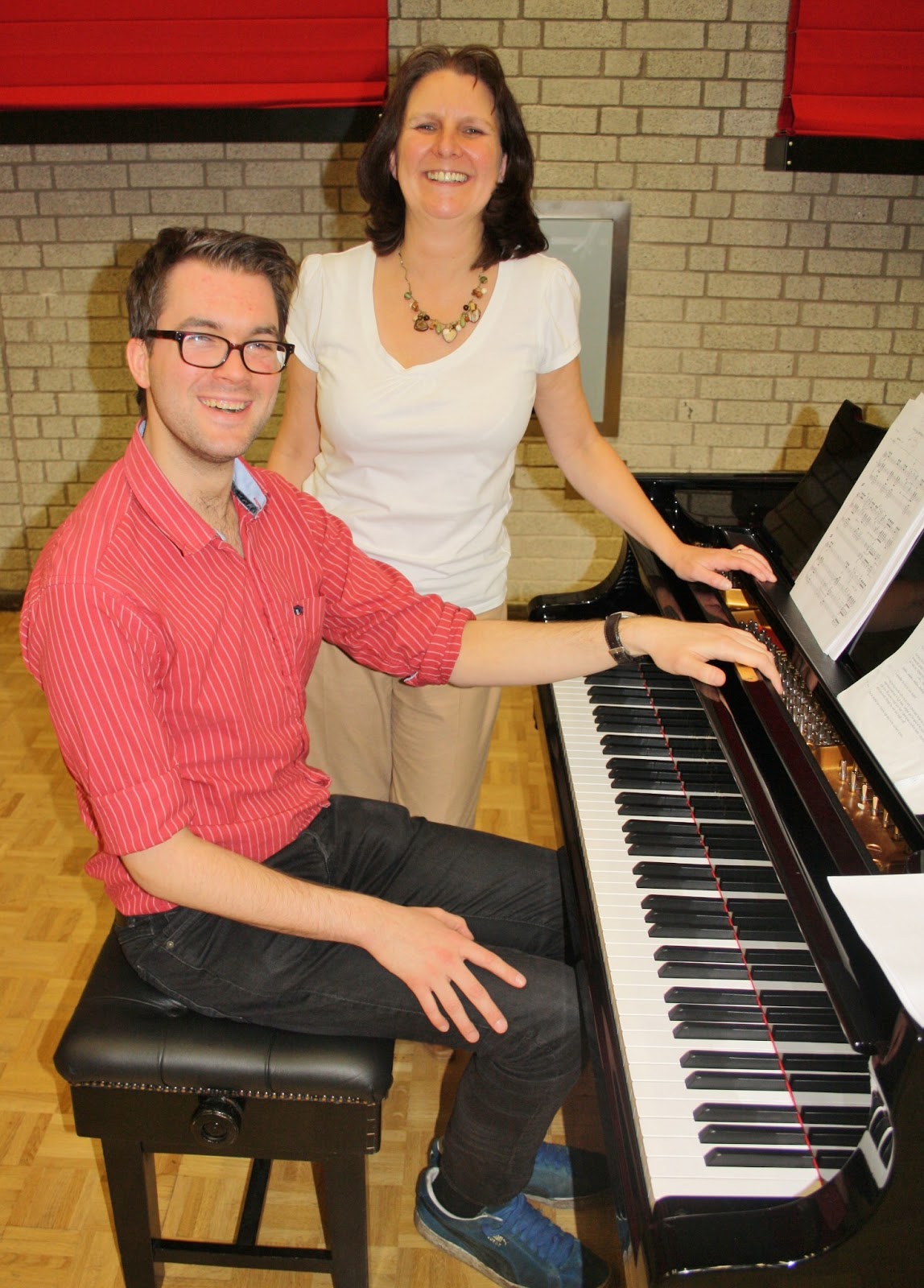
Michael Betteridge and Lynn Pegler at the Royal Northern College of Music.
Their new piece Dancing Dynamite will be featured in a double bill with Spinal Chords by Sally Beamish, which was commissioned for the 20x12 Cultural Olympiad Programme and premiered last summer by the Orchestra of the Age of Enlightenment.
Both pieces include monologues which will be performed by actress Frances Paterson and a string ensemble featuring musicians from the Royal Northern College of Music, conducted by Michael Betteridge.
The concert is free and will take place at the RNCM Carole Nash Recital Room, starting at 6.30pm.
Michael and Lynn won the 2012 Rosamond Prize, organised by RNCM and Manchester Metropolitan University (MMU) Writing School to foster new partnerships between composers and poets. This is their first collaboration since winning the prize.
Michael is a post-graduate composition student at RNCM and Lynn is a public relations consultant and journalist, studying part-time at MMU on the creative writing MA course.
For more information, contact Lynn Pegler on 01928 789042 or Michael Betteridge on 07789 497458.
Issued by Lynn Pegler, Pegler Communications
Tel: 01928 789042. Mob: 07783 686246.

Thursday, 11 April 2013

140 Characters, Directed by Rosie Stuart and Elisa Amesbury


norfox, the Library Theatre Company’s Young People’s Theatre Company, are back with a show all about growing up in a world dominated by social media.

A play devised by young people immersed in technology, exploring the darkness and delight of the world at their fingertips. Join us as we untangle the wires, track the trends and decode identity within the information age.

Friday 12th April £7/4
Sat 13th April £7/4

Free entry to MMU staff


And to shape the production they need your help. Submit your stories in 140 characters via Twitter using the hashtag #StoriesGoViral. The stories can be about anything at all; take us on an adventure, make us cry or set our hearts aflutter. Stories may be funny, scary or completely bonkers, as long as they take up no more than 140 characters. The most playful, creative and inspiring stories will be used to develop the show.

Wednesday, 10 April 2013

Regional Finals Foreign Language Spelling Bee


Foreign Language Spelling Bee, Wednesday, 20th March, MMU

Words and photographs by Sophie Bannister


The atrium in MMU’s Geoffrey Manton building seems particularly multi-coloured today as hundreds of Year 7 pupils in their different-coloured uniforms gather here for today’s regional finals of the Foreign Language Spelling Bee competition.

These pupils have already managed to beat off competition from their fellow classmates to be here today. Now, only two rounds stand between them and a place at the finals that are to be held in Cambridge. To progress, the pupils must spell as many words as they can in their chosen language within 60 seconds. A judge tells them the word in English which they must then translate before spelling. Each word must be spelt correctly or it will stand against them, and all spelling is done using the alphabet of that particular language. The winner will be the pupil who can spell the most words correctly and with the best pronunciation in their 60-second window.

First up is round one of Spanish, French and German. The pupils are brilliant; it is obvious that they have been practising intensely for this competition. They can spell unbelievably quickly and without hesitation once they have been given the word in English. For French and Spanish, due to the high amount of pupils competing, there are two parts to round one.

Competition is stiff and many of the pupils are very determined.

Whilst waiting for the others to finish their first round, German pupils are treated to a lesson in origami paper folding and learning everyday expressions such as, ‘hello,’ and ‘thank you,’ in Chinese. Pupils and teachers alike seem to thoroughly enjoy the workshop, which ends by seeing whose paper frog can jump the furthest.

It is soon time to get back to work as the best three spellers from each language are revealed and continue on to round two. To kick off the final round, the Dean of the Humanities, Languages and Social Sciences Faculty Dr Sharon Handley, stands to give a short speech to all of the pupils who have competed. “It is really important to study languages,” she tells them, “These days, the world is global. Everybody interacts with people around the world. For you to have knowledge of another language makes you a better citizen.” Clearly Sharon sees the many advantages of a competition such as this one.

Soon, the competition has been fought out and the winners of the Regional Finals are announced.

Misha Patel wins the French round.
Shriva Pilli  wins the Spanish round.
Mithylan Ganeshwaran wins the German round.

All three finalists will go on to compete in Cambridge.

It sounds like an unusual competition to enter, but since 2010 this spelling bee competition has gathered more and more momentum, attracting national attention as well as the attention of some major universities, such as MMU. It provides pupils with the tools they require to continue studying a foreign language into GCSE and beyond - a vital skill in today’s multicultural world. It also injects life into learning a foreign language, whilst also refining skills such as spelling, accent and pronunciation, which are sometimes as important as knowing the word itself.

The pupils here today seem to have thoroughly enjoyed competing and many of them are eager to continue learning languages further into their education. The day has been a success. Now it’s time to start practicing for the final in Cambridge!

Sophie Bannister is Co-chair of Manchester Metropolitan University's English Society, where she is currently in her second year studying English Literature. She hopes to complete a Master's degree after her time at MMU. You can view Sophie's blog here